” The measure of a man is not in how he gets knocked down to the mat… it is in how he gets up!”

[This review contains spoilers for the origin of Daredevil (as told in the first 6 issues of Daredevil (Series 1 1964), as well as spoilers from Daredevil (Series 2 1998) issues 1 through 8.]
Daredevil Yellow is a limited run comic book series started in June of 2001. It is the first of “The Color Books” Jeph Loeb and Tim Sale would do for Marvel Comics, focusing on the first months of Daredevil being a super hero. Daredevil Yellow is the perfect reintroduction to the character of Daredevil. While presented to be a starting point for new readers, Yellow does discuss the ramifications of Karen Page’s death, which does not hold the same emotional resonance to a new reader who is learning of her for the first time through the flashbacks in this title. However, Loeb does an excellent job of priming this death with the death of Battlin’ Jack Murdock, Matt’s father. We get quite an extensive backstory into the relationship between Jack and Matt (Which, for once, is a very healthy relationship), and also between Jack and his career – boxing. Loeb and Sale do an excellent job of using background details to set the stage for something that becomes a more prominent feature later on in the story – for example, Battlin’ Jack’s lucky tie from issue 1. In a throw away comment in issue 1, Jack refers to a rather garish colored tie as his “lucky tie”, which just so happens to be the tie that Matt is wearing the night that Jack is murdered. This ability to move the plot along (at a rather quick pace) but also lay the groundwork for these revelations is one of the quintessential parts of a Loeb/ Sale comic.
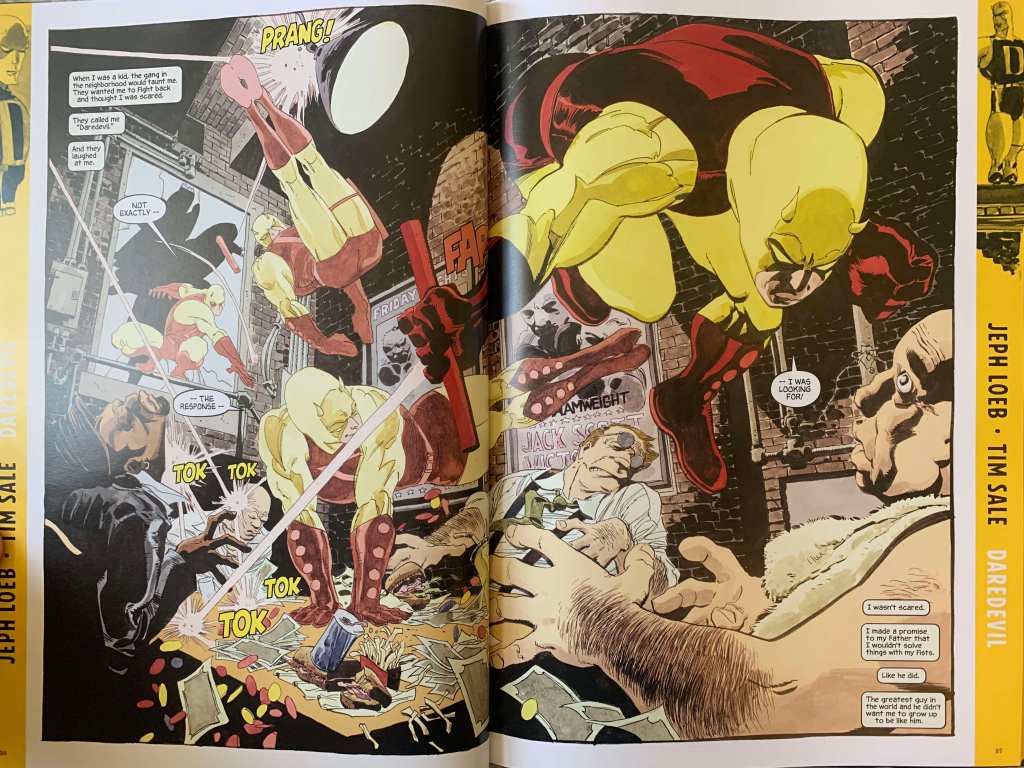
While this comic is an original take on the character, Loeb and Sale were obviously harkening back to the first 6 issues of DD back in 1964 – the Fantastic Four make an appearance, Electro and Owl play a large role, and they also create an in-universe reason for both the original yellow costume and the more recognizable red one. It creates a feeling of respect for the original material, but also superseding their spot.
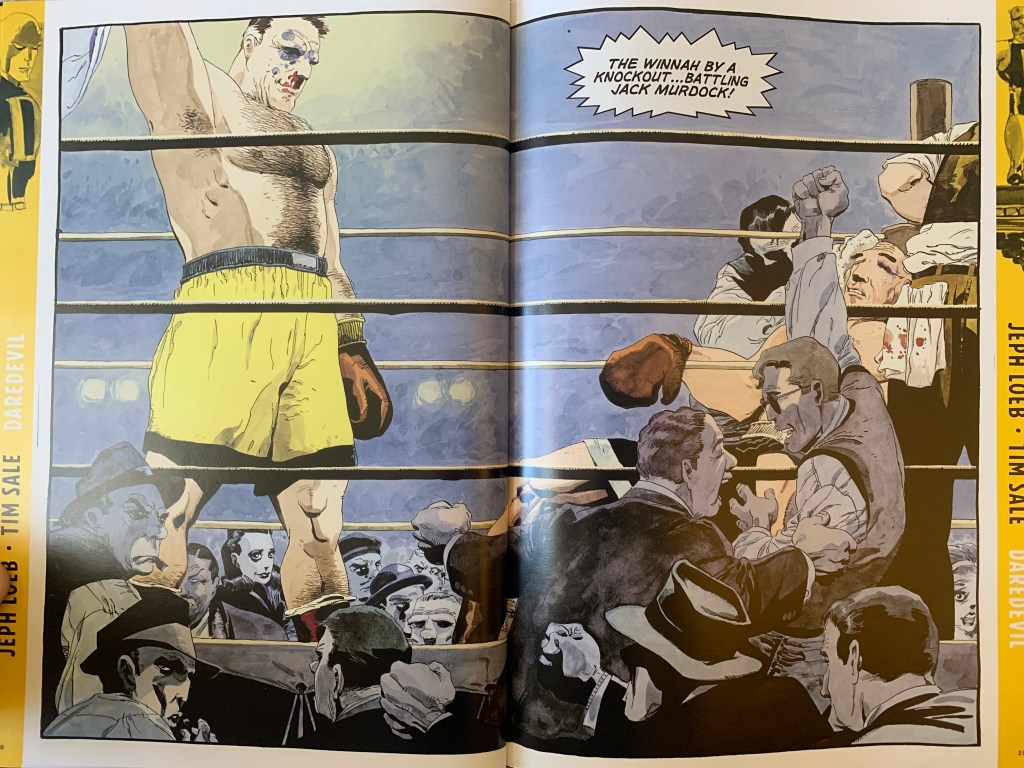
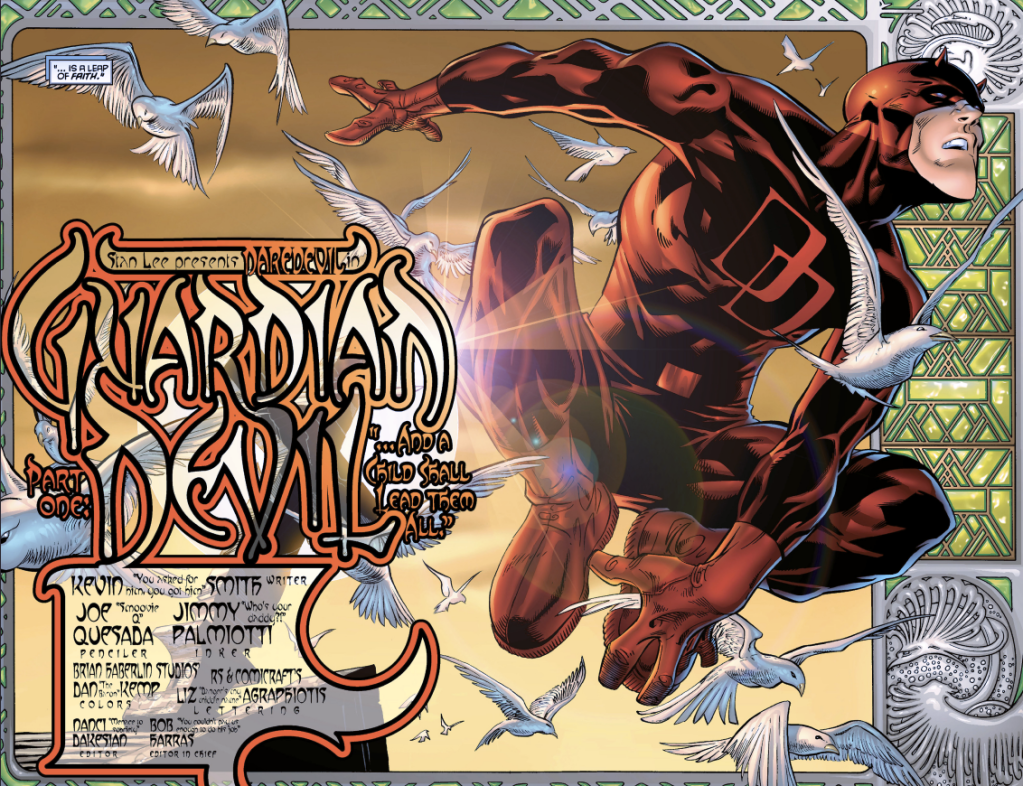
I would be remiss if I did not take the time to properly recognize the beautiful art of this book provided by Tim Sale and Matt Hollingsworth. In the introduction to the gallery edition, Loeb goes into detail about how Sale and Hollingsworth came up with the ink-wash technique for the inking. “He [Sale] poured India Ink … into a coffee cup and added water. It diluted the ink so it became more of a watercolor finish.” In regards to Hollinsgworth, “Working in Photoshop, Matt [Hollingsworth] transformed Tim’s [Sale] gray washes into color, creating the impression, for the reader, that the pages were originally rendered in watercolor.” What all of this, practically, creates is comic book artwork that invokes the feeling of classic Americana like a Norman Rockwell painting. One of the things that so often gets overlooked in creating comic book adaptations for modern audiences is that silver age and golden age comics were products of their time. Coloring, rendering, posing, costume attire – all of these were products of the 40’s and 50’s. These were (more often than not) the ideas of day-dreaming young men imaging what heroes and villains would look like and act in their day and age, not the future. It’s the reason that classic comic outfits look really silly in modern movies or tv shows – Captain America’s original outfit with the goofy boots evokes feelings of swashbuckling pirates, something people in the 40’s would be aware of. All of this to say, Sale understood this and chose an art style that would remind us of “classic America”. Counter to this point, Sale also uses faded images of DD to show movement, and uses splash pages in each issue to set the tone and mood – things that were not common in the 60’s. He also uses color and shading to draw the attention of the reader to the main characters or the focus of a particular panel – the characters in the background of the boxing match in issue 1 are in gray scale, while the boxers are in full color. It is a genius way to not show the reader what matters, but also to highlight the characters perception of what matters – in this particular scene it showcases that Matt only has eyes for his father who is the one fighting in the ring.
Ultimately, I believe that Daredevil Yellow is the best origin story of the character.
“When you’re young you think you are going to live forever.”
It is hard to read that line in a post Tim Sale (1956-2022) world and not tear up or get a lump in your throat. Daredevil Yellow, at its heart, is a story of loss, grief, and acceptance. Matt Murdock is struggling with the recent (in continuity) death of his on again, off again love interest Karen Page, but he was not the only one. According to Loeb and Sale, they were “destroyed” when Karen died. “We wanted to remind the readers of the joy that Karen brought into Matt’s world.”, Loeb recounts in the introduction to the Daredevil Yellow Gallery Edition. As strange as it might sound to say that a story about “loss, grief, and acceptance” is joyful, Daredevil Yellow is for sure. Joy is not about covering the sadness and loss, smothering it and removing it – Joy is about accepting that the loss is there, but choosing to find comfort in the memory that you got to experience the happiness at all.
Daredevil Yellow is best experienced by reading several DD comics prior, including the first 7 issues of DD 1964, the first 8 issues of DD 1998, and/ or watching the first 2 seasons of the DD Netflix/ Disney + Tv show. Yellow has been collected in graphic novel, gallery edition, and in the Colors Omnibus, and is still relatively easy to find in individual issues. Yellow is not necessarily a must read in the continuity of DD, and someone who is wanting to just read the main fulcrum issues of DD can skip this book with no issues.
 Vying For Time
Leave a comment