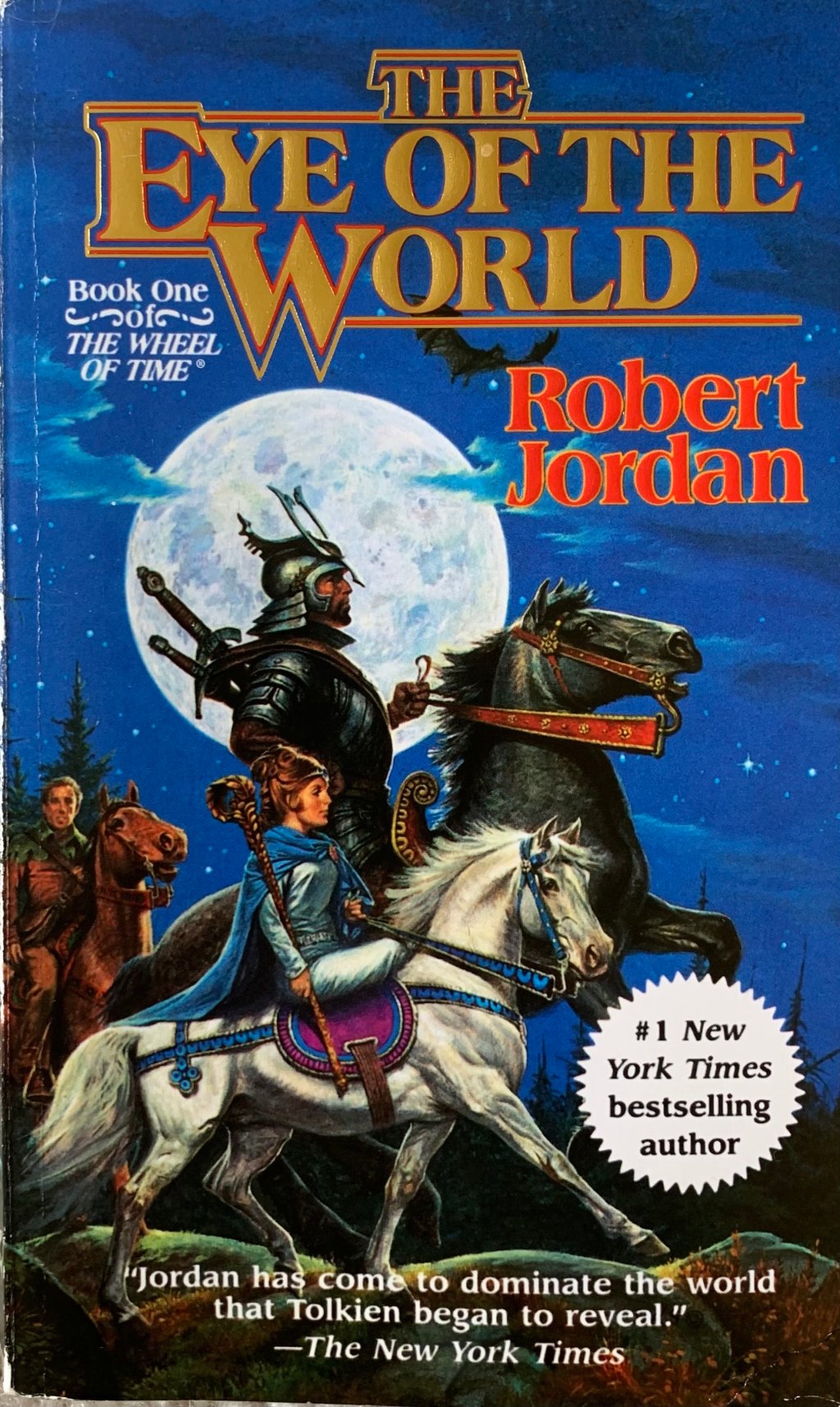
The Wheel of Time turns, and Ages come and pass, leaving memories that become legend. Legend fades to myth, and even myth is long forgotten when the Age that gave it birth comes again. – The Opening Lines of Chapter One
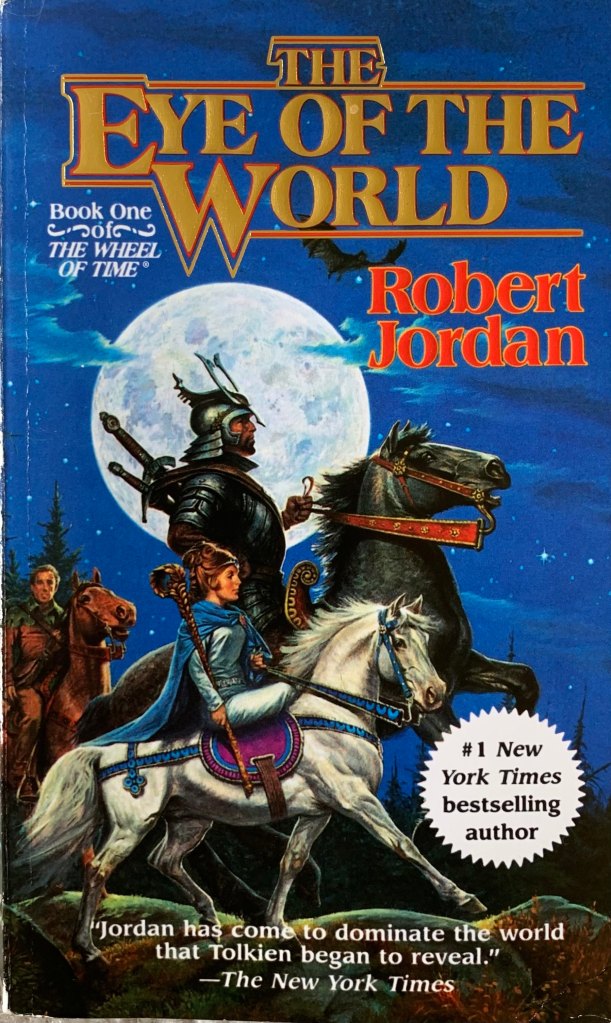
The Eye of the World (EoTW), Book One in The Wheel of Time series created by Robert Jordan, is an epic fantasy novel about the conflict between destiny and freewill, reincarnation and the cyclical nature of human history and culture, and, ultimately, growing up. While these are tropes indicative of the genre as a whole, I feel that EoTW approaches these themes from a different viewpoint than most. Prophecy underlines most of the decisions of the main characters, but instead of embracing prophecy and accepting their role in destiny, many of the main characters reject their calling, even commenting on how “this never happens in the stories!” Jordan further differentiates himself from his contemporaries by choosing to base his religious system on
Immensly important to the weight of the emotional impact of this novel is in it’s ability to curb expectations; to pull the rug out from underneath the reader. Jordan starts the novel in media res with one of the best starting chapters to any story ever. You are introduced to Lews Therin Telamon, who is presented as a madman navigating a ruin of his own creation. He is surrounded by dead bodies of servants and friends, but does not seem to see them. We are also introduced to Elan Morin Tedronai, Betrayer of Hope, presented as an adversary to Lews Therin. We are given a introductory glance into the time period of the novel, roughly the High Middle Ages, and a display of the magic system. Then, pulling the rug out from the reader, we jump (presumbly) forward in time to a completely different place with different characters, and a teenage narrator. The next several chapters heavily mirror the plot of The Lord of The Rings, with a country town preparing for a huge party and the main character anticipating arrival of an outsider with news of the happenings outside the village. However, unlike Frodo’s quest, Rand and his friends Mat, Perrin, and Egwene are attacked at the culmination of the festivities. Not only that, but the Gandalf character, Moiraine Damodred, is an Aes Sedai, a witch of sorts who inspires both fear and awe in the eyes of the people. The teenages do not know what to think of Moiraine’s vague guidance, but know that nothing will ever be the same. The reliance on subverting expectations continues throughout the book, and allows Jordan to both nod to those who came before him in the genre, and also carve his own place.
One of the pillars of good fantasy writing is being able to present the fantastical in a grounded and relatable way – being able to create a world in which mythical creatures exist that look very different from humans, but act in a way that we can relate to and grow attached to. To this end, Jordan combines historical cultures to create new and interesting cultures for the characters to interact with. While this novel does rely on the “farm boy having a wise guide through a brave new world” trope, there are very few instances of info dumping on the reader. In fact, the main bulk of the novel is not dialogue but observations by Rand to set the stage and tone for the reader. As Rand leaves Emond’s Field, the agrarian village in which he spent all of his life, we slowly see the villages grow into towns, and towns eventually grow into cities. Jordan does a phenomenal job of slowly but surely increasing the scope of the story – villages to cities, trollocs to myrddraal, eventually introducing far away lands and even new species of peoples. By the time that more and more is piled on to both Rand and the reader, we are more familiar with the basic building blocks of the world and can accept more and more information.
Perhaps the most integral aspect of what differentiates The Wheel of Time from other fantasy novels is the heavy reliance on partial truths, hidden motivations, and unreliable narrators. The world of the Wheel of Time is very divided when it comes to the sexes. Men and woman have very different roles within society, and also different roles within the magic system. Woman are able to channel magic with very little fear aside from drawing too much of the power and forcibly extinguishing the ability from themselves. Men, however, cannot channel without being exposed to the taint of the Dark One, and eventually going mad. One of the common critiques of the series in general, and especially the first few books, is that the men and women in the story lie to eachother more often than not. About 90% of the inherent conflicts within the story could have been avoided if the characters involved would have been honest about motivations and information. While this is a genuine critique, I feel like this is less a literary crutch and more indicative of the world that Jordan is trying to create. In this world, Men who can channel go mad, and everyone knows that Lews Therin will be born again (as a man) and is destined to destroy the world. Why then, would women trust men, and why would men trust women when Aes Sedai are all women and are known to be moving kings and queens like pieces on a chessboard? To complicate this further, most of the story is told through the perspective of Rand, who is an ignorant farmer. Many people who show up through the story to tell of news are unreliable narrators telling stories to Rand that are either skewed or not true at all. There are few people in which Rand can trust, so when he begins to withold information from other characters we are hardpressed to disagree with the decisions. Not to mention the fact that almost all of the characters in this book are under the age of 20, and act accordingly.
The Eye of the World is the benchmark for epic fantasy novels. EoTW is a novel that asks much from the reader – asks, not demands – in the way of fantasy names, cultural customs, long-winded explanations, and a fifteen issue series. But, if you can make it through the initial hurdles, EoTW has incredible wealth to offer. There are hints to revelations much later on in the series, and characters that will be immensly important in later books, sprinkled throughout. You will get teases to lands and peoples that you will get to see later on if you stick with the series, and you get to see these plot threads grow and develop and, eventually, end in satisfying ways.
I cannot praise and recommend The Eye of The World enough, but I also believe that the first novel is indicative of the story and writing as a whole, and if anyone is not sold by the end of it, then they can comfortably exit the series with no reservations. Ultimately, Wheel of Time is a fifteen book series and there is no amount of payoff that will justify sticking with it if it does not mesh with your preferences.
Robert Jordan passed away in 2007 after publishing Knife of Dreams, Book Eleven, in 2005. The Wheel of Time is one of the few epic fantasy stories that has a defined ending, and even though Robert Jordan did not live long enough to finish the book series himself, his wife and editor Harriet McDougal saw the series finished through Jordan’s extensive notes and Brandon Sanderson writing the final three novels weaving his own words with Jordan’s. I personally did not notice a difference between the switch in writers, though I understand the hesitation from some to accept a new writer on one of their favorite book series.



 Vying For Time
Leave a comment