
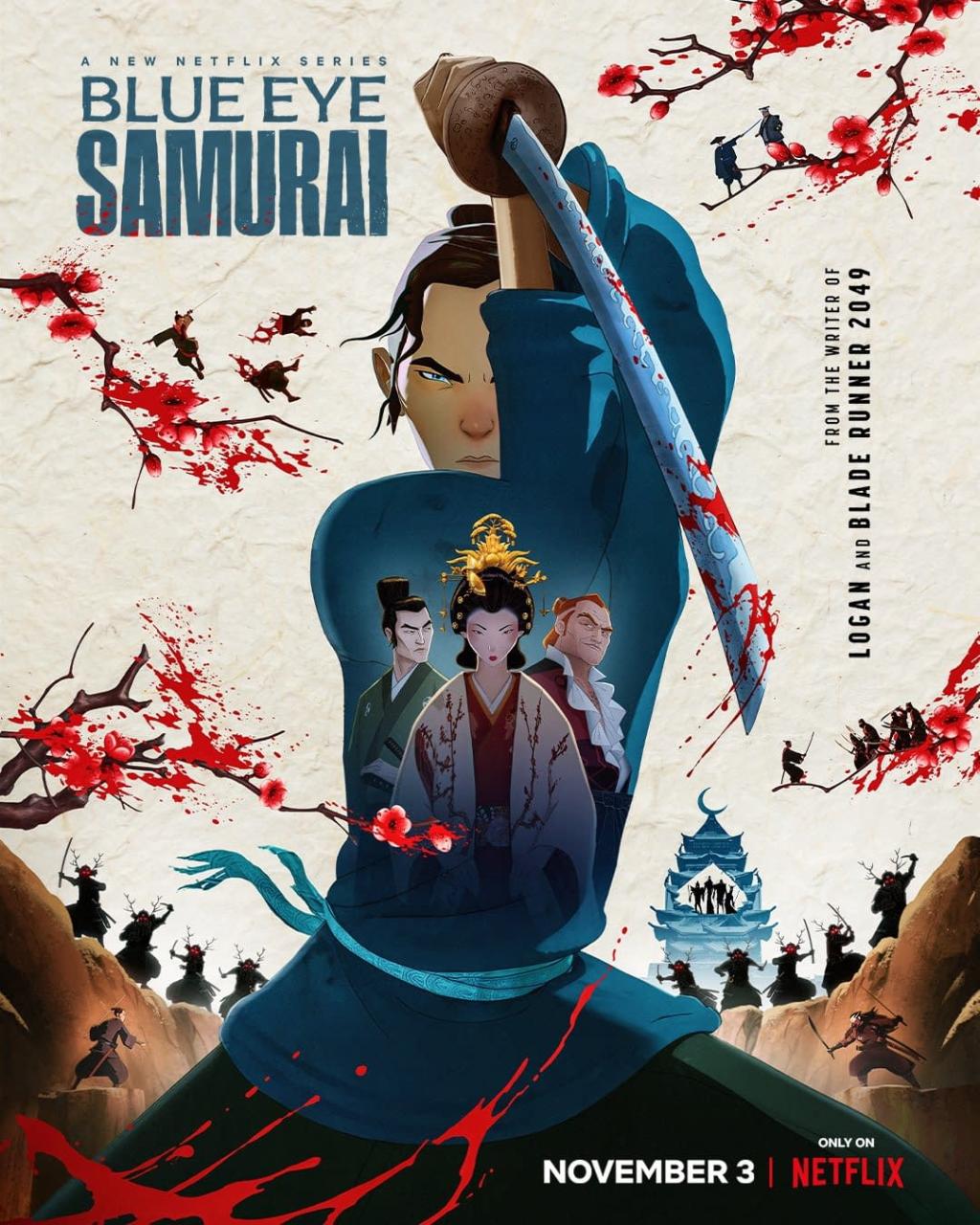
In 1633, Japan closed its borders to the outside world. Completely. Citizens would never see a white face, nor any face that was not Japanese. A child born mixed race would be considered less than Human. Pitiable. Impure. Monstrous. From these times rose a Legend.
— Opening Lines to Blue Eye Samurai, Episode 1

Blue Eye Samurai is an animated historical fiction set in Japan in the 1600’s following the titular ‘Blue Eye(d) Samurai’. I hesitate to refer to this show as an anime, since the animation style is more akin to FMV cutscenes of video games from the 90’s/00’s, but the subject matter and tone is definitely anime. And as such, It was so far off my radar that I never would have even heard about it except for a recommendation from my brother. I tend to steer-clear of anime in basically all facets (and tend to erroneously yell ‘Weebo’ at anything Asian-adjacent), but the fact that I am still watching the series after 5 episodes is quite possibly the highest honor I have given an anime ever. I continue to be surprised by how great the writing is and the extensive use of literary devices that put this miles ahead of what I thought anime could be.
[This analysis contains spoilers for most of episode one of Blue Eye Samurai (BES)]
To understand BES, there is one truth that all of the characters in the show believe – European blood is contaminated, and anyone who is of mixed blood is considered less than a dog. To convey this, the show puts great emphasis on color, and especially the color blue. Blue is, of course, the eye color of the Samurai protagonist, but also the color of the meteor that crash lands and saves them from being killed by bullies as a child. Blue is also the color of the outfit the Samurai wears, and the color of their sword. However, blue is not used on the dress of the antagonistic characters – they tend to dress in more earth tones – yellows, greens, browns, or red. Back to the meteor and the role it played in the Samurai’s childhood – not only did this meteor physically save them (saving them from a rock that would’ve most certainly cracked their skull), but it also spiritually saved them by creating the incident that would lead them to their new father-figure, the “Sword Father” as they call them. The Sword Father, while initially reluctant to keep the young orphan around, would quickly find them very useful around the forge because of their own “deformity/ handicap” – he is blind.
The first episode does a wonderful job in highlighting the duality of handicaps and deformities – the perceived limitations of them, and the actual limitations of them. The Samurai is perceived to be a monster and abomination due to their Blue eyes and mixed blood, but in reality is one of the few characters in the first episode to show compassion and humanity. The Sword Father is blind, and therefore society would deem him incapable of artistic expression, but is able to be one of the best smiths in Japan. And that brings me to the character of Ringo. Ringo is one of my favorite characters in the entire show – when we are introduced to him he is working at a noodle restaurant with his father, helping prepare meals and working as a waiter. While not noteworthy in and of itself, this is quite a magnificent feat due to his handicap – Ringo does not have hands. Instead, Ringo has wrist bands that he uses to secure tools – chopsticks, cooking implements – to aid in his day to day life. Obviously, to someone like myself with hands, I find the notion of not having hands to be truly limiting, but through Ringo and his adaptation to his circumstances we are shown that you can overcome and be more than society expects of you.
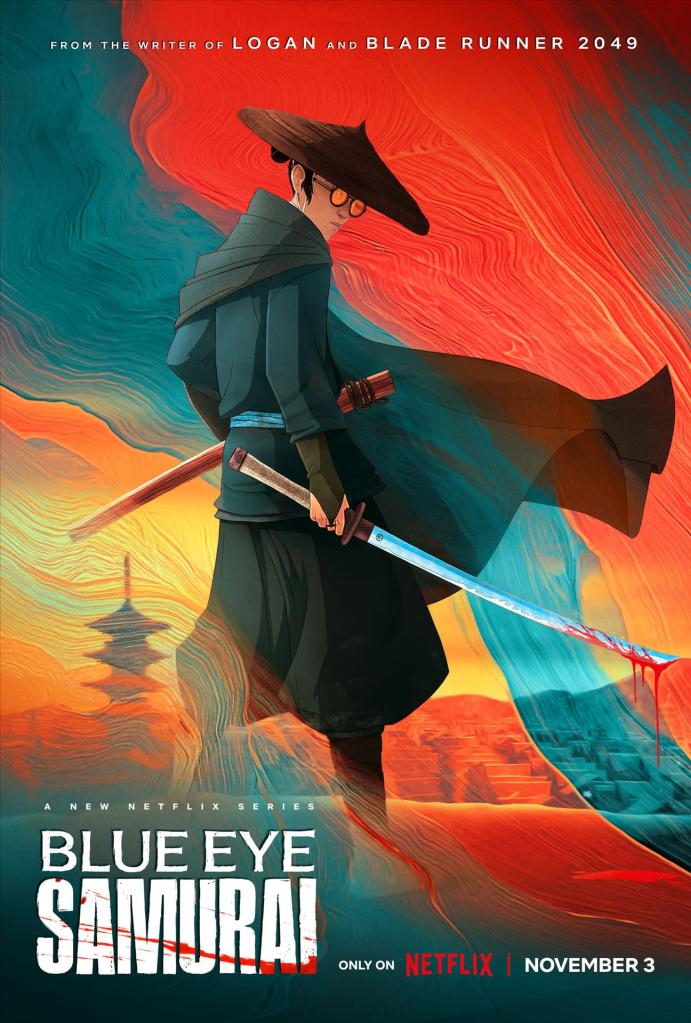
The last point that I want to discuss is one of societal roles. I know I have a spoiler warning earlier in the article, but I am about to spoil the main plot point of the entire show and the ending of the first episode. Please, if you are at all interested in the show and have gotten to this point without watching the first episode stop reading now.
Japan, and really a good portion of the world at that time, had incredibly strict paths laid out for individuals based on their sex, upbringing, and physical limitations. Early in the episode we are introduced to the characters of Taigen, a duelist who is currently on a 24 duel winning streak and has brought much honor to his house, and Akemi, the princess of Kyoto. Taigen is the son of a fisherman who has, through his impressive sword skills, managed to escape the path of his father. He has impressed the ruler of Kyoto and has even been considered as a potential suitor for his daughter. Akemi, the daughter in question, is a princess and as such has a certain degree of expectation pushed on her from her father and those of the royal court. She is expected to be a bridal gift to another powerful family and, through her marriage, secure their lineage into the Shogunate. Instead, she falls heads over heals in love with Taigen – substantially strengthening his position within the city and potentially weakening hers. But this is only one potential path for women in 17th century Japan. The Samurai, upon entering Kyoto, has to go through a military checkpoint. At the checkpoint we are shown a woman carrying her wares to sell in Kyoto, and her daughter. They are denied passage into Kyoto due to them not having a male escort, and later on in the episode we see their (presumably) dead, frozen bodies. Later, inside the city walls, we are shown the last avenue for “success” for a woman in these times – the brothel. All of this is made even more poignant when we are finally shown that the titular Samurai is actually a woman, who is banding her breasts and masquerading as a man. Between The Samurai, Taigen, and Akemi, we are presented with three extraordinary, rule-breaking individuals who are attempting to carve their own destiny and their own way through this incredibly strict and traditional world of 17th century Japan.
Blue Eye Samurai has been an eye-opening experience. It has captivated me with its animation style and visuals, and kept my attention with its wonderfully intricate and touching story. The fight scenes are appropriately brutal and swift, and contrast beautifully with the exposition and dialogue between genuinely well-written characters. I do not know if this show is enough to breakthrough the walls I have put up between myself and anime, but I can say it has made a valiant effort. Blue Eye Samurai currently has one season out on Netflix, with a second season on the way with a tentative date of 2026.


 Vying For Time
Leave a comment