I am the living weapon. I am the blade that cuts both ways. I am the masochist and the narcissist. Rigid and fluid. Corrupt and pure. I am a White-Hot … Clenched Fist … Of Rage … And Iron. – Danny Rand, the Iron Fist – Issue 1 of Iron Fist: The Living Weapon (2014)
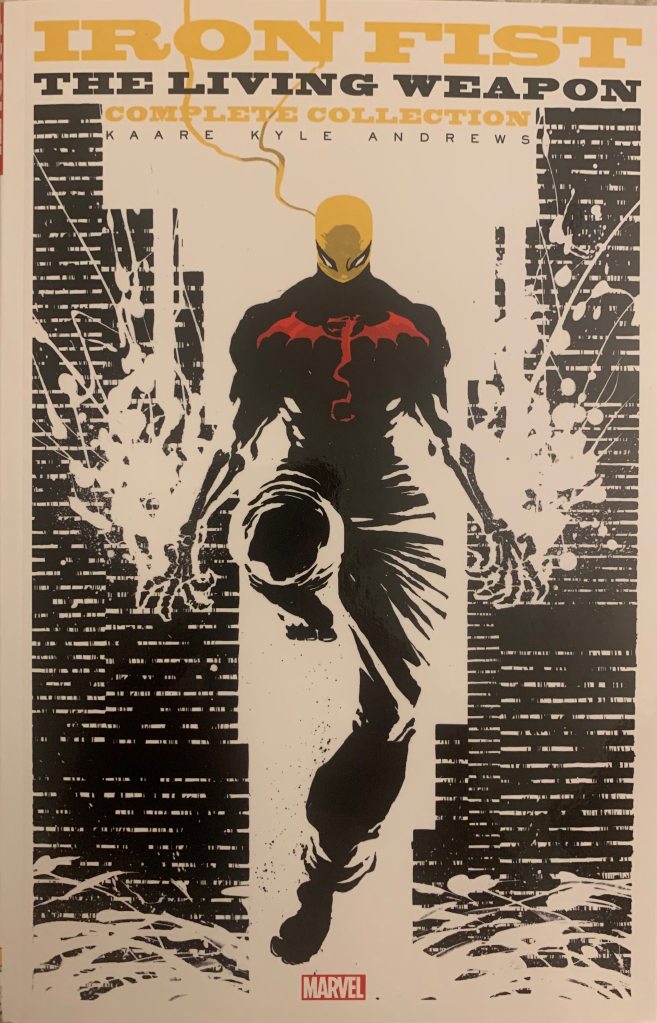
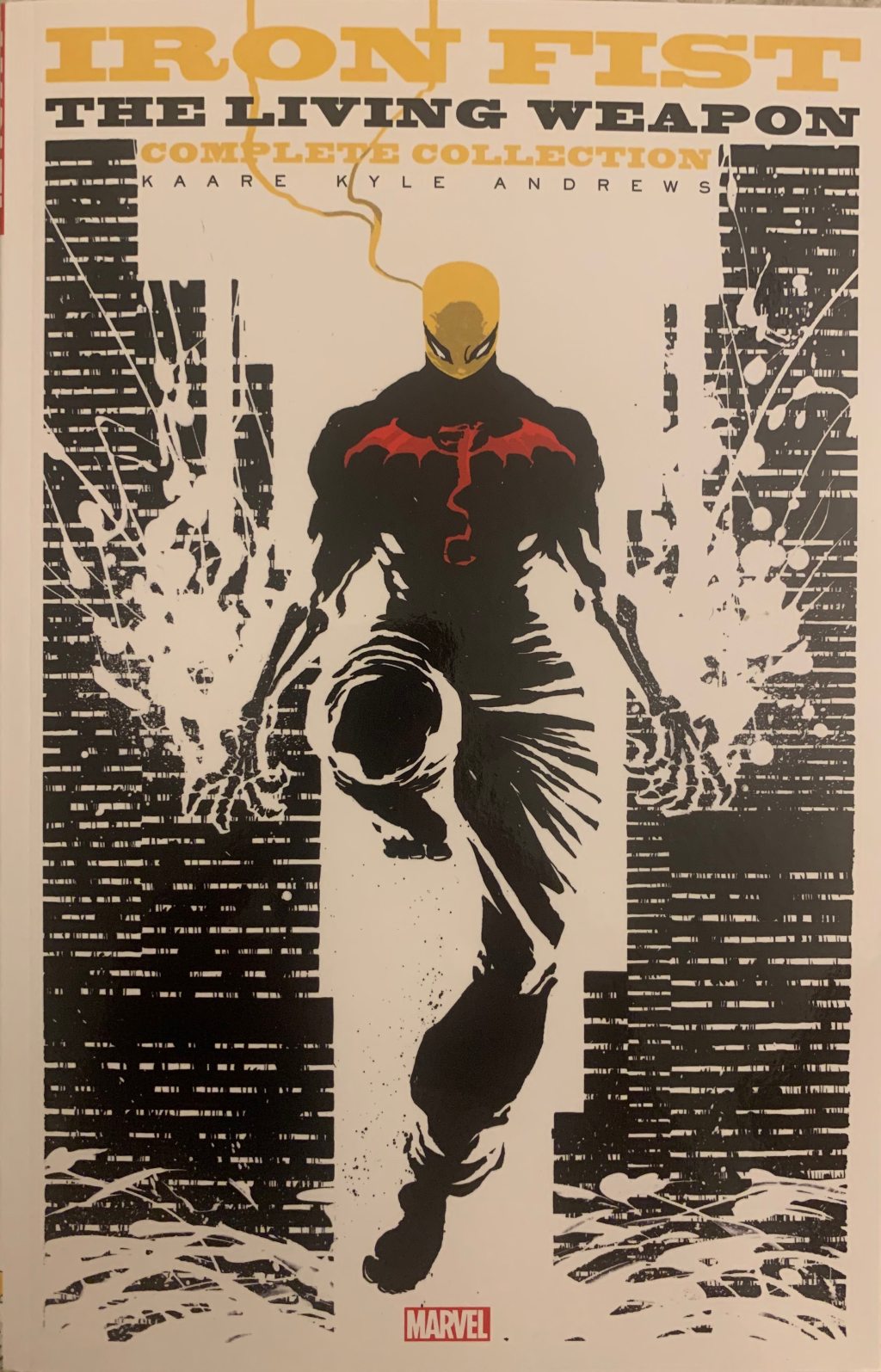
I was first exposed to super heroes through Justice League Unlimited on Cartoon Network, followed shortly by Batman The Animated Series and Batman Beyond. I never read any comic books as a child, which I learned later in life is quite uncommon to get into comic books as an adult first. I would continue to see super heroes in video games like Marvel Ultimate Alliance 1 & 2, or in cartoons like Spider-man and His Amazing Friends and the X-men Animated Series. Whether consciously or subconsciously, I fell in love with the “street heroes” side of both Marvel and DC comics – from Daredevil to Batman, Moon Knight to Nightwing, Black Panther to Elektra, I loved the idea of (semi) regular people taking the initiative and helping out their local community. I cannot remember the first time I saw the Iron Fist, and it might have even been in Daredevil Volume 2, but I loved his look and his outfit. The dragon on the chest and the glowing hands – I was sold. But the look of a character will only take you so far, and I had yet to truly meet the character of Danny Rand. When I started reading comics weekly in 2014, I picked up my first Iron Fist issue with Iron Fist: The Living Weapon (IF:TLW), and immediately fell in love with not only Danny Rand, but also Kaare Kyle Andrews as a comic book creator. IF:TLW is a showcase on what is possible with comic books as a medium – a masterclass in visual story telling through Andrews’s effective use of framing, composition, and blending of art and written word.
[This includes spoilers for the first issue of Iron Fist: The Living Weapon, as well as a summary of the origin story]
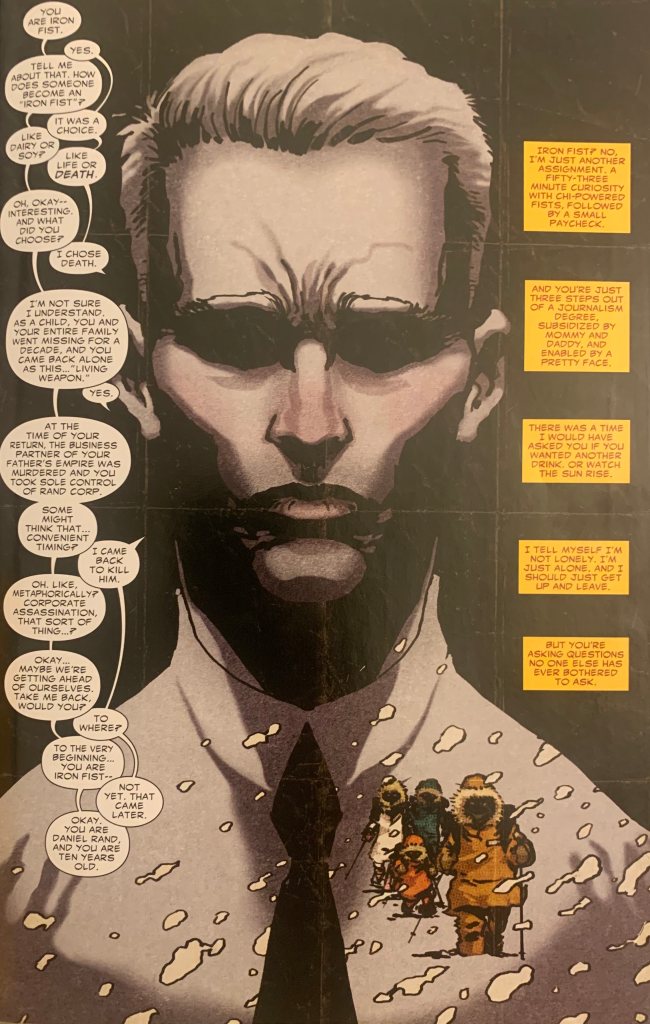
It is common within the comics industry for writer and artist to exist somewhat separately when creating the comic – creating a product where there is significant overlap between what the art is showing us and what the story is telling us. In contrast, Kaare Kyle Andrews is the writer, artist, inker, and colorer for IF:TLW, allowing him to give us an undiluted glimpse into his vision for the comic. Looking at page 1, the composition is a single splash page, with two columns of word balloons on either side of the splash page, creating a bookend. Danny is shown in shadow – deep, hollow eyes with no pupils or color, wearing a white collared shirt with tie. He is talking with someone off scene, his focus is not on them, but on the past. As you follow the left column to the bottom, we are given the briefest glimpse to the white blotches on Danny’s shirt, before being pulled back to the other column on the right side. In contrast to the white balloons on the left, these blocks are harsh and yellow – Danny’s internal monologue also harsh and judgemental. Then, at the bottom of the column, we again reach the white blotches but this time we see that Danny’s shirt is not just a shirt but a field of snow and a portal to his past. Every element on this splash page has a purpose, and perfectly sets the tone for the story. In a previous article on August: Purgatory Underground by Benjamin Morse, I talked about the importance of creating a strong connection between the reader and comic, and how in independent comics it is so much harder because there is no brand recognition. While Iron Fist as a character has existed for nearly 40 years at this point (2014), Andrews’ interpretation of the character is much different. Just with this first page, Andrews effectively sets the stage for the rest of the series and lets the reader know what to expect.
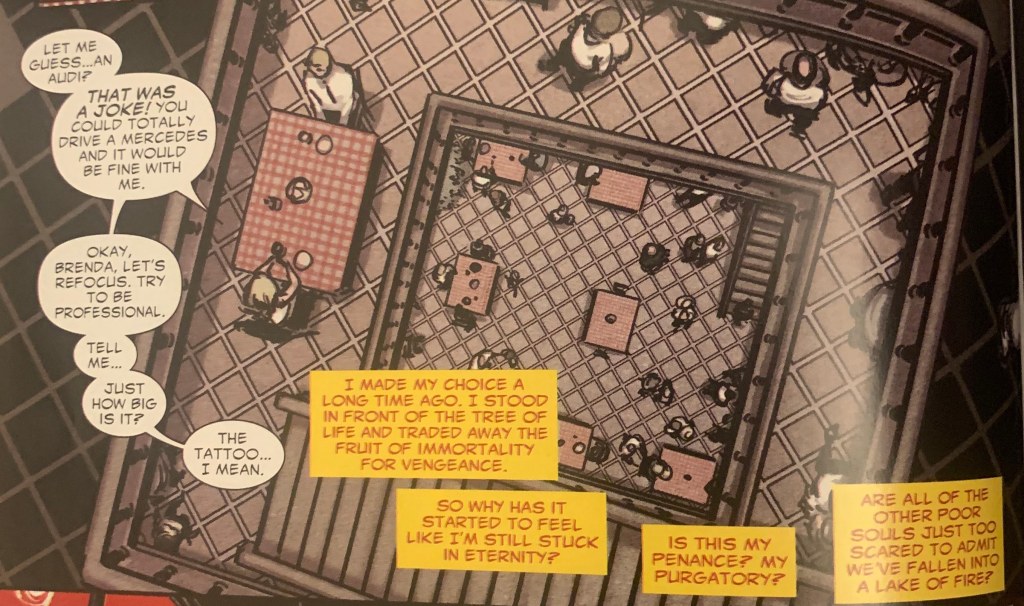
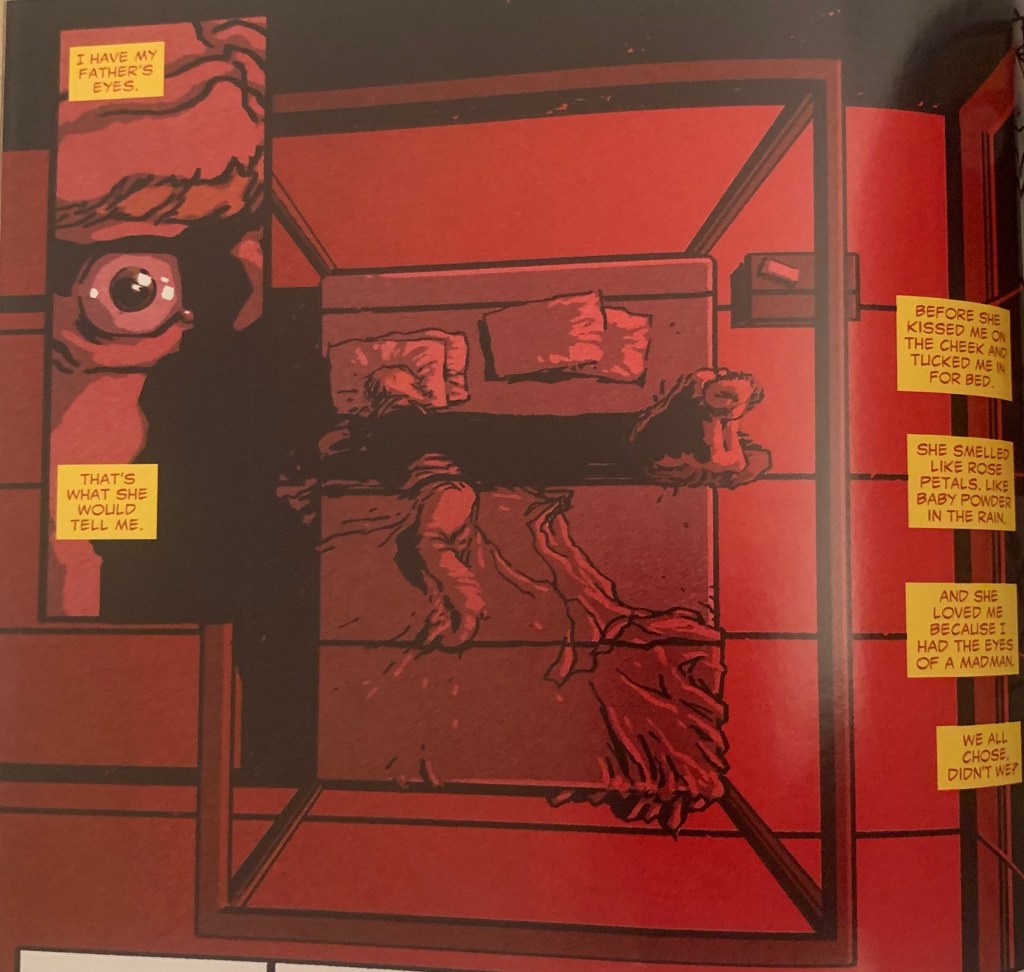
Andrews uses an art style for IF:TLW that is dark – using heavy shadows and monotone colors. The pencil lines are scratchy with heavy borders on characters. There is heavy use of negative space – highlighting how lonely Danny Rand feels. This is not the happy-go-lucky Danny Rand from the 70’s – the hip, kung-fu fighting philanthropist. This Danny Rand is disillusioned to the life of superheroes. He is loathing, destructive, and apathetic. He is still super-powered, but not quite heroic. He is remembering his childhood and the death of his father – something that happened in flashbacks in the original series by Roy Thomas – but reacting to it in a very human way. Historically, tragic things would happen to lead someone on the path of super-heroism, but they would not leave a lasting imprint on the character’s psyche. Andrews explores this idea by focusing on this notion of revenge vs healing. While Danny successfully hunted down his father’s business partner in the early years, we see that the quest for revenge did not lead to healing for Danny. There are two pages in the first issue that are beautifully arranged to convey this sense of helplessness and loneliness Danny is going through. Danny is having a conversation with a reporter in a busy restaurant, with wait-staff and other customers all around. Instead of framing the scene showing their faces switching back and forth, or even from a distance like we are sitting at a nearby table, Andrews instead frames the scene from straight above. This unorthodox view might not coincide with a realistic point of view, but it does an excellent job of showing how trapped and alone Danny feels. He is near the center of the scene, with the walls of the room drawn like the bars of a prison floating in empty space. The second scene shows Danny and the reporter in bed after a one-night-stand. While not quite the same scene, since they are alone in Danny’s bedroom instead of a busy restaurant, Danny is still shown in the center with the bedposts creating a cage. The difference here is in the body language of Danny – he is sitting up, staring at the window – he is contemplating leaving the cage. As the reader, we are unsure at this point as to how Danny will effectively escape his cage, but Andrews quickly answers this by showing Danny jumping out the window through the glass. Did he jump to his doom, or is there something else he is jumping towards?
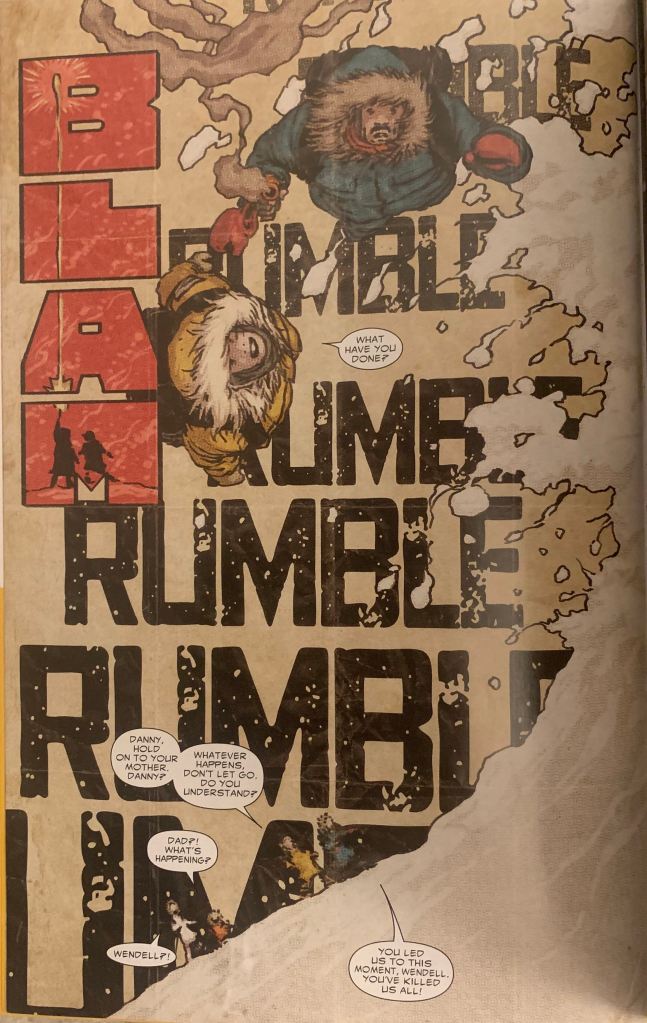
Lastly, I’d like to focus on the use of words and word balloons within the art itself to fulfill a specfic purpose. As discussed earlier, there can be a disconnect between story and art, and some of this is due to the nature of word balloons and the fact that they are placed on top of finished artwork blocking some of the scene. While Andrews is not credited with the lettering in this book, I believe that is more in reference to the stereotypical word balloons and not the onomatopoeia embedded within the artwork itself. Regardless, the artwork on display on page 4 is both densely packed and easy to follow, showing a clear understanding of comic book pacing and layout. The page is fairly simple and can be broken down into three sections: section one is the onomatopoeia of “BLAM”, which is the only 4 panels on the page and contains Danny’s mother and Meachum shooting off a flare, section two which is an arial shot of the two of them looking up at the flare, and section three which is a far away shot showing Danny, his father and mother, and Meachum with an approaching avalanche. All three sections exist within the same nebulous page with no drawn background, and instead have the words “rumble” repeated from top to bottom, growing in size and intesity as you go down the page. While I could go on and on about every single page of this issue, I will just ask that you trust me in my assessment that this entire series is full of gorgeous art – any one of the pages could be on display in an art exhibit showcasing what is possible in comic books.
Iron Fist: The Living Weapon is not a traditional comic book by any metric. Andrews’ depiction of Danny is not going to resonate with everyone, and some of the sequences later on in the story are graphic and quite traumatizing; but I truly believe this to be a character defining run. Andrews carved his own special section out of the Iron Fist mythos that hasn’t really been touched upon since, but deserves to be read and experienced. It is becoming more and more rare for a single comic book creator to be both writer and artist, especially within Marvel or DC, but IF:TLW is such a highlight of the medium. I would not necessarily recommend reading this run for a person just getting into the character of Iron Fist, but if you’ve read Roy Thomas’s run from the 70’s, or Brubaker’s run from the 00’s, this is a wonderful run to read after that to see a new take on the character.

 Vying For Time
Leave a comment