“Ah-hah; whom have we heah, what what?”
“Please,” said the Wart, “I am a boy whose guardian is Sir Ector.”
“Charming fellah,” said the Knight. “Charming fellah. Never met him in my life.”
- Chapter 2, Exchange between Wart and King Pellinore
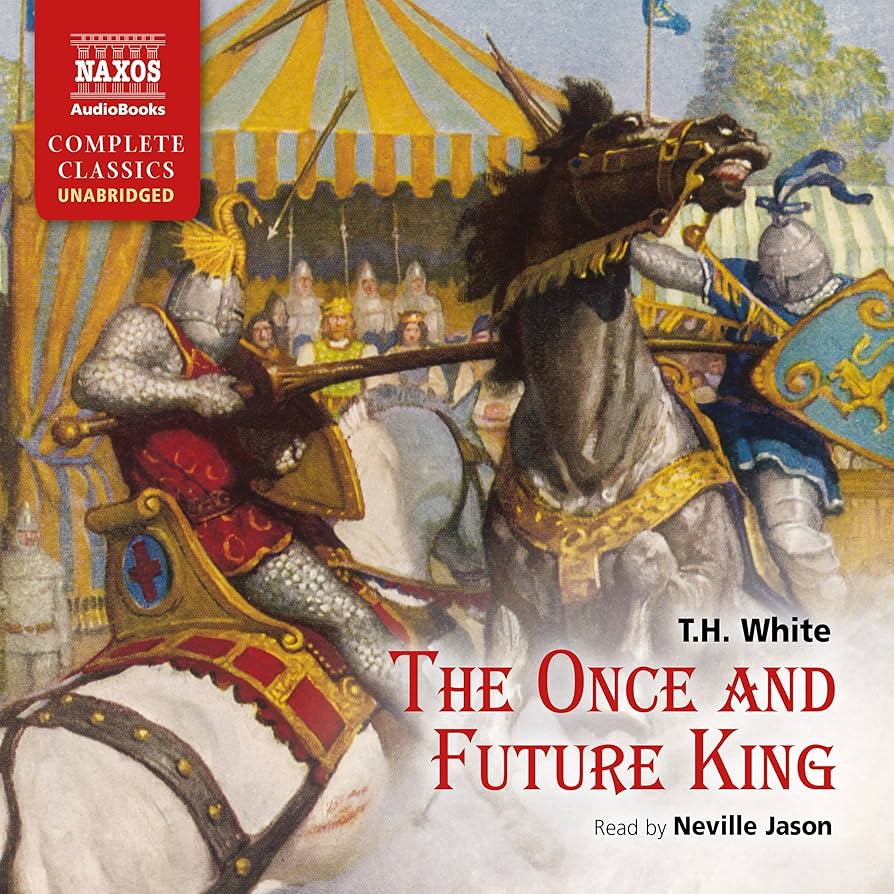
I am no stranger to the fantasy genre; or at least I did not believe myself to be. Growing up in the early 2000’s everyone was obsessed with Peter Jackson’s Lord of the Rings movies, which captivated me at a young age. I read Harry Potter in elementary school, Chronicles of Narnia in middle school, and The Lord of the Rings and His Dark Materials in high school. I dipped my toes into science fiction with C.S. Lewis’ Space Trilogy, tried out Herbert’s Dune, was introduced to Jordan’s The Wheel of Time by my now wife in college. I say all of this to confess that I knew very little of King Arthur and Arthurian Legend in general. I knew who King Arthur was, after all I’d seen Disney’s The Sword in the Stone when I was incredibly young, but the characters of Galahad and Guinevere and Lancelot were obscure. I researched where to start with Arthurian Legend, and was guided to check out The Once and Future King by White as a great starting point. Imagine my surprise listening to the first few chapters on audiobook and realizing that this is Disney’s The Sword in the Stone, or at least the source material for such. But then, after discussing the plot with my brother and wife, I realized that White managed to achieve the impossible – White created a book that is incredibly deep and critical of modernity, while also being hilarious and genuinely witty. And even more impressive, the book is better than the movie.
The main players in The Sword in the Stone (TSitS) are Wart and Kay (juxtaposing the two as congenial adversaries and boyhood friends), Merlin (the Deus Ex Machina character and general fulcrum for the plot), and the Knights Ector (Kay’s father and Wart’s guardian), King Pellinore (A good natured but idiotic fill in for medieval tropes), and Sir Grummore Grummurson (The stereotypical chivalric knight). The story is told through a series of loosly related events pertaining to the childhood of Wart, as he is tutored by Merlin with the goal to prepare him for his destiny. Merlin, it is revealed, is from the future and literally “born at the end of time, aging backwards through time to the beginning of time”. Effectively, this is a creative way for White to have Merlin fulfill the trope of “Wise Man explaining to the young rural teenager the ways of the world” and also be able to commentate, in universe, on current events. One of the things Merlin has in his hut when he is first introduced is an actual tank. Yes. A tank. The whole book is written like that – a strew of random facts and observation from an omnipotent narrator (White himself most likely) who is aware of the works of Mallory to which most of these stories are derived, and then, randomly, White will insert the funniest bit of British Humor I have ever heard. The book almost reads like the Bible, in the sense that every chapter is an independent story with a parable at the end and a lesson or commentary.
The unsung hero of this experience, or rather, why I am recommending the audiobook specifically, is Neville Jason. Jason is the reader of the version of the audiobook that I purchased, and is quite possibly the reason that I enjoyed this book as much as I did. One of my most prominant hobbies is to go walking through the parks listening to audiobooks and enjoying nature, and I found myself going on much longer walks than normal because of his phenomenal narration. He perfectly captures the essence of every character – Wart’s childish naivety, Merlins whimsy and matter-of-factness, Pellinore’s oafishness and general goofiness. There is a wonderful exchange in the middle of the book between prisoners in their cells and their jailer (who happens to be a giant), and Jason manages to turn the scene into something straight from Monty Python. I’m sure White’s story stands on its own and would be a great read as well, but Jason adds so much to the story especially when it comes to his back and forth exchanges where characters ask repetitive questions – these can come across as dull when reading them, but when hearing them you realize how natural of an exchange it actually is.
The Sword in the Stone by T.H. White is quite possibly the pinnacle when it comes to children’s stories – the bar for entry is low enough that a young child or teenager could read it and understand the plot and learn from the parables, while an adult can read it and understand the deeper meaning between the lines and the diatribes from characters like Merlin or Pellinore. If you want to dip your toes into Arthurian Legend to better understand stories like Wheel of Time by Robert Jordan, or you simply have nostalgia for the Disney movie, you will love TSitS. The audiobook version narrated by Neville Jason is phenomenal and would make a perfect listen during a long flight or commute.
All that being said, the book does have some outdated (racist) views and interpretations, particularly when it comes to Native Americans. I did not personally find the comments to be too off-putting (White was born in a time when social Darwinism and European-exceptionalism were still taught as factual and not inherently racist and incorrect), but I do feel the need to point them out and make you aware of them.
If you are interested in my overview of the first book of Robert Jordan’s Wheel of Time, the link to that is here.


 Vying For Time
Leave a comment