The sirens are screaming and the fires are howling
Way down in the valley tonight
There’s a man in the shadows with a gun in his eye
And a blade shining oh so brightOpening of Title Track, Bat Out of Hell
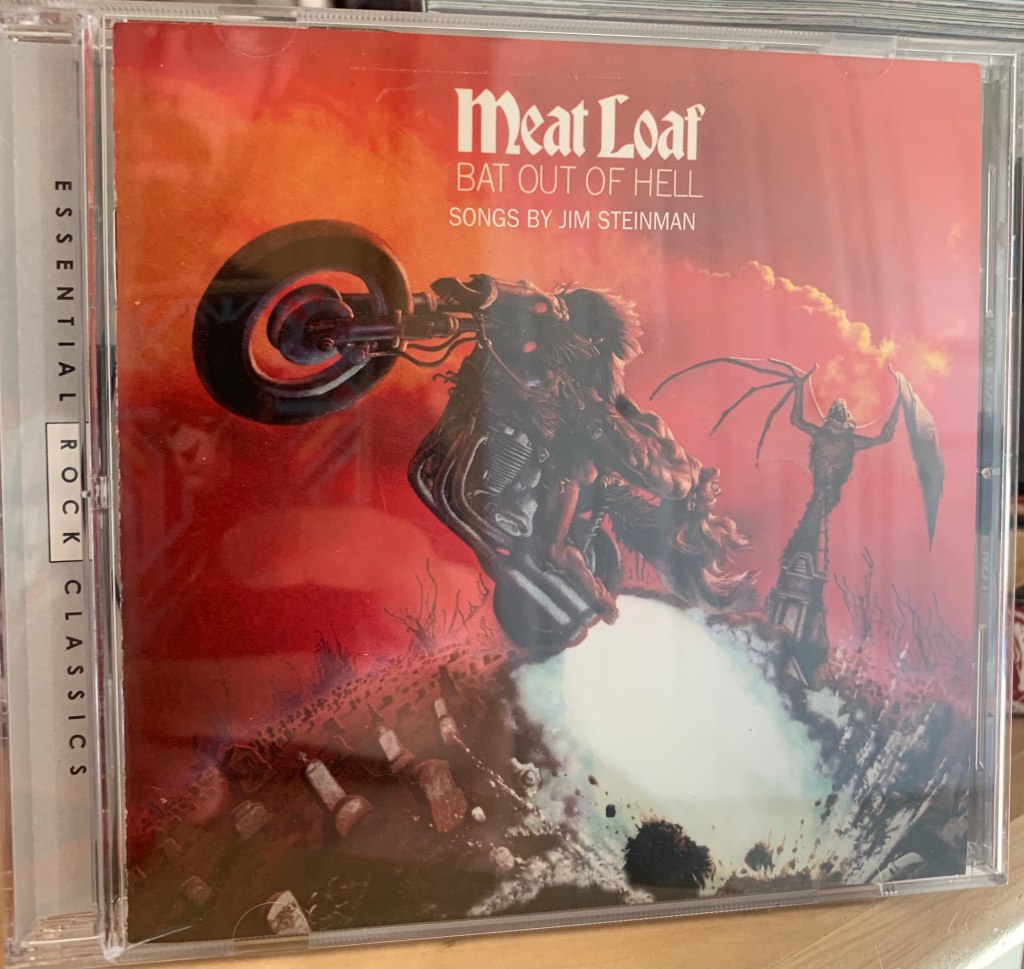
There are certain things in life that you feel like you always knew – things that you can’t quite remember ever not knowing. The moon comes out at night, don’t stare at the sun, those types of things. But then there are things that you feel like you should remember learning or experiencing for the first time – for me, that is Paradise by the Dashboard Lights by Meatloaf and Jim Steinman. I can remember, vividly, riding in the 2003 Ford Taurus, in the backseat with my brother beside me, mom in the passenger seat and dad driving, riding on preston highway in Hillview, Kentucky. Sun bright and shining, and on the radio, Meatloaf. We were all singing (though now that I write that, Dad probably wasn’t), me being entirely too young to understand the implications of the song. Little did I know, over a dozen years later, I would invite my future wife over to my apartment for the first time to listen to vinyls. She went through them and pulled out Bat Out of Hell, looked me in the eyes and asked “Do you know this album? Like, have you actually listened to it?” “Yes, of course! I love Meatloaf – Paradise by the Dashboard Lights is an amazing song!” She would tell me later that, when she was also a child, she had said ‘if she ever met a guy who knew this song [Paradise by the Dashboard Lights], I would have to marry him.’ Bat Out of Hell is an incredibly sentimental record for me, but one that I don’t feel enough people know of contemporarily – yes, it is one of the best selling albums of all time so some people know of it, but not enough people under the age of 35. Bat Out of Hell is the perfect musical, the ebodiment of teenage angst and “rock and roll”, and saying it is just another rock album is downplaying both Meatloaf’s performance and Jim Steinman’s composition and song writing. Bat Out of Hell has more in common with Phantom of the Opera or Epic: The Musical then it does with The Eagles or The Rolling Stones. It is a performance, plain and simple. And like any performance, you have to experience it to believe it – let’s ride!

Bat Out of Hell, like most musical arrangements and plays, is a story over 2 acts – coinciding with the A side and B side of the original vinyl. The A side, what I’ll refer to as “The Chase” of the story – the rising action and the setup, revolves around a pair of unnamed male and female characters and their adolescent summer love affair. The opening song, which is also the titular track “Bat Out of Hell”, opens with a barrage of electric guitar riffs and synthesizer, almost fighting back and forth for the spotlight. The lyrics paint a vivid picture of urban hell – squalor, violence, evil, and the downtrodden and innocent who are unable to escape. The line “Like a bat out of hell I’ll be gone when the morning comes” can be interpreted in two ways – one being that the singer is spending the evening in his lover’s embrace, but leaves her in the morning before she awakes, painting this picture of him being unable to commit to the relationship beyond the physical attraction and lust – the other, which I believe, is that something is keeping them apart. There are later lines in the song referring to their love affair as sin, and that “if I gotta be damned you know I wanna be damned dancing through the night with you”. Steinman is quoted with saying the album is a “rock futuristic version of Peter Pan” and focuses on a specific aspect of rock’n’roll culture that he explains is “where romance became violent and violence became romantic.” There is this frequent mention of light and dark in the physical sense with the sun and moon that makes me wonder if these is a physical pull for the male character during the sunlight, and that only at night can he creep away to be with the love interest. These themes are further explored in “You Took the Words Right Out of My Mouth (Hot Summer Night)” and “Heaven Can Wait”. Hot Summer Night invokes a scene of lovers intwined on a beach at night, getting further and further from their original “line in the sand” of the relationship and eventually culminating in sex. The important story takeaway from this song is what the singer means from the line “you took the words right out of my mouth and I swear it’s true I was just about to say I love you”. On the outset, it means exactly what he says – he was about to profess his love and then, when she kissed him, he could not due to having the air escape his body. However, there are hints later in the album that he was unable to say he loved her, the words meant something that he was unable to commit to at the time. The words were an outword expression to not only her but to the beyond that he would stay with her, something that he could not say. The final song on the A side of the album, “Heaven Can Wait” circles back to this notion of heaven and hell in the physical sense and this idea that the singer and the woman are committing sin by being together. “I got a taste of paradise – If i had it any sooner you know – You know I never would have run away from my home.” This juxtoposition of the words ‘paradise’ and ‘heaven’ in the song are deliberate – while some might think of heaven as a paradise, the singer has seen and touched paradise and knows it is with the woman, not somewhere else.
The second half of the album, both musically and thematically, is a stark contrast to the first half. Where the first half was bombastic and confrontational, the second half of the album is more subdued, more submissive, letting Meatloaf’s singing shine through, as well as the female vocalist Ellen Foley. The first song is “Two Out of Three Ain’t Bad”, the first time in the story that we have confirmation that the relationship is not going well. The chorus, “I want you, I need you, but there ain’t no way I’m ever gonna love you, now don’t be sad ’cause two out of three ain’t bad”, shows the distinction between sex and love, circling back to the initial point of their relationship on the beach when he cannot say he loves her. An interesting aspect of this song is the admission of the male character at the end of the song that this manipulation that he is putting the woman through, he had done to him in the past. While he is acknowledging his dissatisfaction with the event, he does not seem to be aware that he is forcing her through the same pain. The song ends with “baby we can talk all night, but that ain’t getting us nowhere” which I always found to be an extremely sad and foreboding way to end it – basically him admitting that this situation sucks, but he is who he is and she is who she is and they are doomed to be unhappy together. The bulk of side B is the song “Paradise By the Dashboard Lights”, my favorite song on the album and the song that I feel best displays the composition and lyrical genius of Jim Steinman while also showing Meatloaf’s vocal range and showmanship. Paradise starts with a jiving keyboard opening, harkening back to the 50’s or 60’s sockhops and dancehalls – the lyric booklet included in the CD even refers to the male lead as “boy” here, showing he is much younger than in the rest of the story. This first section revolves around the stereotypical scene of the young couple driving up to a roadside pulloff, possibly looking over the town, and they begin to get intimate. Steinman ends this first “movement” with a baseball announcer intermission as a thinly veiled allegory to the baseball terminology of intimacy at the time (If you’re unfamiliar, ask your parents!), which is voiced by Yankees’ shortstop Phil “Scooter” Rizzuto, which is a nice touch. But before they can go “all the way”, the female singer causes an abrupt halt with “stop right there!”. The second movement starts – Let Me Sleep On It. This section is a discussion turned argument between the couple where she demands to know that he is in fact in love with her and will not be leaving in the morning, but he insists they can have this discussion “in the morning”. This is an allusion back to the beginning of the album with the character leaving “like a bat out of hell when the morning comes”. The conflict is not resolved in this movement, however, and continues into the third and final movement – Praying for the End of Time. After much back and forth, the boy shouts in exasperation “I started swearing to my god and on my mother’s grave that I would love you to the end of time” and gives her the contract she was needing. This is a quite hilarious moment (as an onlooker, not for someone in a failing marriage), in which both the male and female characters go on to say “so now I’m praying for the end of time to hurry up and arrive!” It is unclear, at least to me, whether this relationship is the same relationship as the A side of this record, or whether this is just a set of similar circumstances presented to create a cohesive feeling. Regardless, at 8:29 runtime, this song is totally different than any other song on the album and crowns the album off quite well. The final song, “For Crying Out Loud” is a ballad of acceptance, admittance, or submission. My feeling on this song is that, at the end of time (whether figuratively with the Peter Pan character aging, or literally at the end of all life), the male lead finally realizes that he does in fact love his wife. Their relationship was not founded on sound principles and true love, but through proximity and mutually shared experiences, they grew to love one another. Their love is not the goal, not the blueprint to which anyone should follow, but a representation and romanticization of young love. Deeply flawed, like a flame that will spark quickly and grow out of control, but burn out just as quickly and leave only ash. The somber tone is deliberate, and no matter how many times I listen to the album through, I always feel melancholy at the end of it. It is a story that does not have a real happy ending, and honestly, they probably do not deserve one. It is a tragedy of classical proportions.

I feel it is my duty in presenting this album to give special consideration, again, to the duo that was Jim Steinman and Meatloaf. Steinman’s style was incredibly unique and uncompromisingly 70’s. Besides working with Meatloaf on Bat Out of Hell and the sequel, Steinman also wrote and produced “Total Eclipse of the Heart” for Bonnie Tyler, among songs for Barry Manilow, Celine Dion, and Sister’s of Mercy. He wrote several songs originally intended for Meatloaf post Bat Out of Hell, but Meatloaf ended up falling into the same trap most rock’n’roll stars fall into, drugs and alcohol, and left the music industry for over a decade. Meatloaf would return to music with two sequel albums to Bat out of Hell, that include many songs by Steinman. Meatloaf’s singing style and stage presence were, to say the least, non-traditional, but he was incredible showman. It is very much worth your time to watch a live performance of “Paradise by the Dashboard Lights” from the first Meatloaf tour to see just how energetic and electric he was. Steinman and Meatloaf’s relationship was strained in the 80’s and early 90’s, but it appears that they were able to reconcile in their later life. Steinman passed away in 2021 at 73, and Meatloaf passed a year later in 2022 at the age of 74.


 Vying For Time
Leave a comment