The same acquaintance who was just here, Leroux, to dismantle any nastiness that might have been waiting for me. Surely you must have heard of him? His name is — Moon Knight. – Steven Grant, Hulk! #12
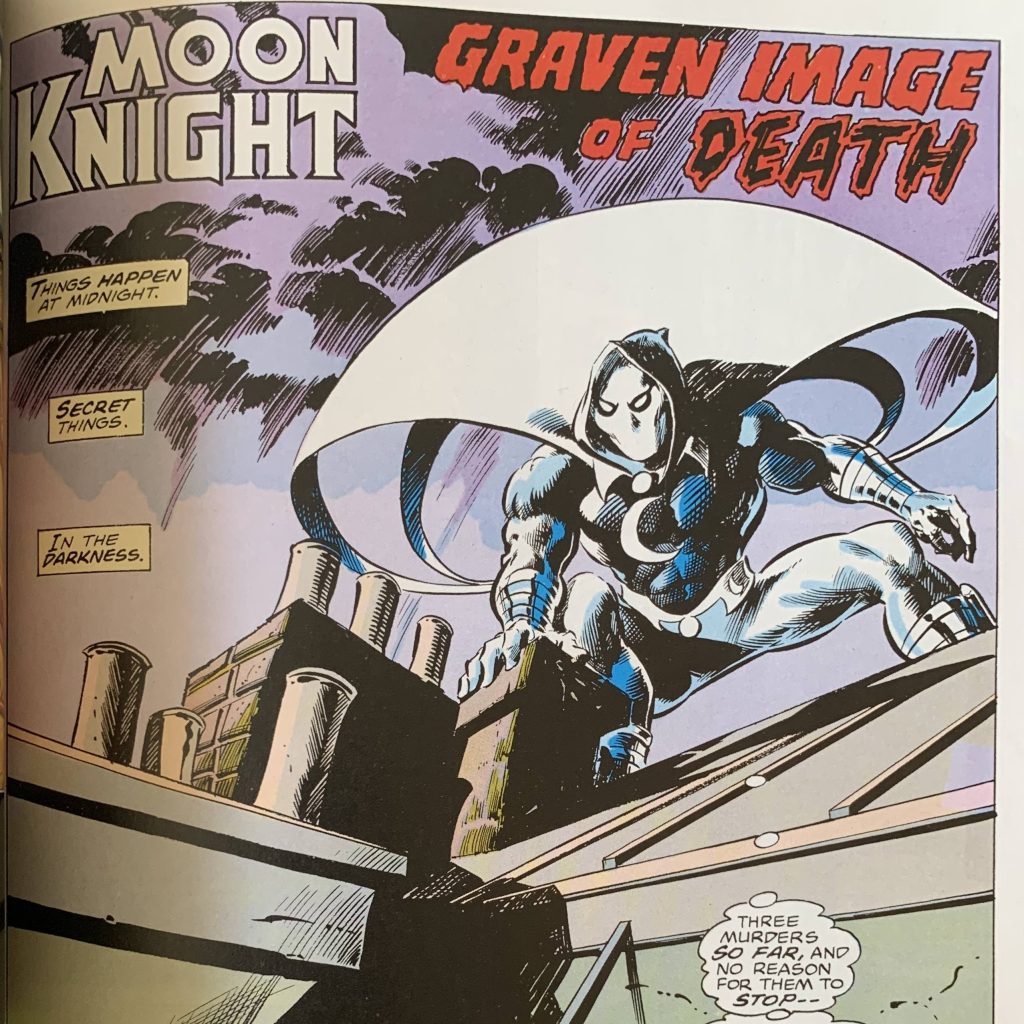
In my previous article on Iron Fist: The Living Weapon by Kaare Kyle Andrews, I spoke about my first introduction to Marvel super heroes through the video game series Marvel Ultimate Alliance. Two of my absolute favorite characters to play in that game that I knew nothing about were Moon Knight and Black Panther. I remember talking to someone, might have been my brother or one of my friends, but they said “Isn’t Moon Knight just schizophrenic Batman?” That analogy, while correct in a general sense, is quite damning to the character of Moon Knight – many times I feel that we as fans of something, are highly critical of derivative characters or perceived knock-offs. We feel the need to defend “our” series or character by creating a false equivalency that undercuts the nuance of the new character or series. That being said, Moon Knight by Doug Moench in an incredible example of taking a derivative idea and creating a unique niche for said character. Moench started his run on Moon Knight with the debut of the character in Werewolf by Night #32 (1975), but, in my honest opinion, Moench doesn’t hit the ball out of the park until the storyline that started in Hulk! Magazine #11 (1978) and ran through issue #14 (1979). The Hulk! Magazine was aimed at a more mature audience, to which Moench was able to capitalize with Moon Knight. Prior to this depiction, Moon Knight was a more goofy character, fighting the titular Werewolf by Night in his first few appearances, and then being moved to the “joke team” of the Defenders. Despite these previous appearances, Moench reels Moon Knight back to a more gritty detective type story, more reminiscent of Batman by Dennis O’Neal and Neal Adams. Let’s take a deeper dive into issue 11 of Hulk! and look at how Moench is able to do a “Batman type story” but make it unique to Moon Knight’s abilities and personality.
Before we start with the issue, there is a little background to understand a few plot points of this issue – one is the attire of Moon Knight, and the second is the dissociative identity disorder (DID) of the character of Mark Spector (note, the creators refer to this as “schizophrenia” in the book, which is an antiquated term and not reflective of the disease in current context. They did not do this with malicious intent and I’m sure is just a reflection of the medical knowledge at the time. Also note, I am not a medical professional and will most likely ill-represent the disease as well later in the article. Cut me some slack – I have a biology and agriculture degree!) In Moon Knight’s first appearance (WBN #32), he is given the guise of the Moon Knight from “The Council”, a shadow organization hell-bent on capturing a Werewolf. In the framing of that issue, Spector is a mercenary for hire who has a background in most martial arts and marksmanship, not a super hero – or super villain. As such, his suit is not his own creation and is not something that reflects anything within his subconcious like say Batman’s or Daredevil’s. Second point, up to this issue Moon Knight is one of three persona’s of the same person – Moon Knight the masked vigilante adept in martial arts, Jake Lockley a witty and streetwise cab driver useful for navigating the criminal underworld, and Steven Grant a billionaire playboy with the money to fund all of Moon Knight’s gadgets and vehicles. Notice, I did not mention Mark Spector – at this current point in time, there is no clear distinction between Mark Spector and Moon Knight himself – some characters even refer to Moon Knight as Mark. It is established that Mark is the original persona and the reason for all the wealth that Steven has, but not a person that grants him any different “powers.” This will come up in future stories and become the fourth persona of the character.
[This article contains spoilers for Hulk! 11, though modern uses of Moon Knight have retconned some of these. Proceed at your own risk]
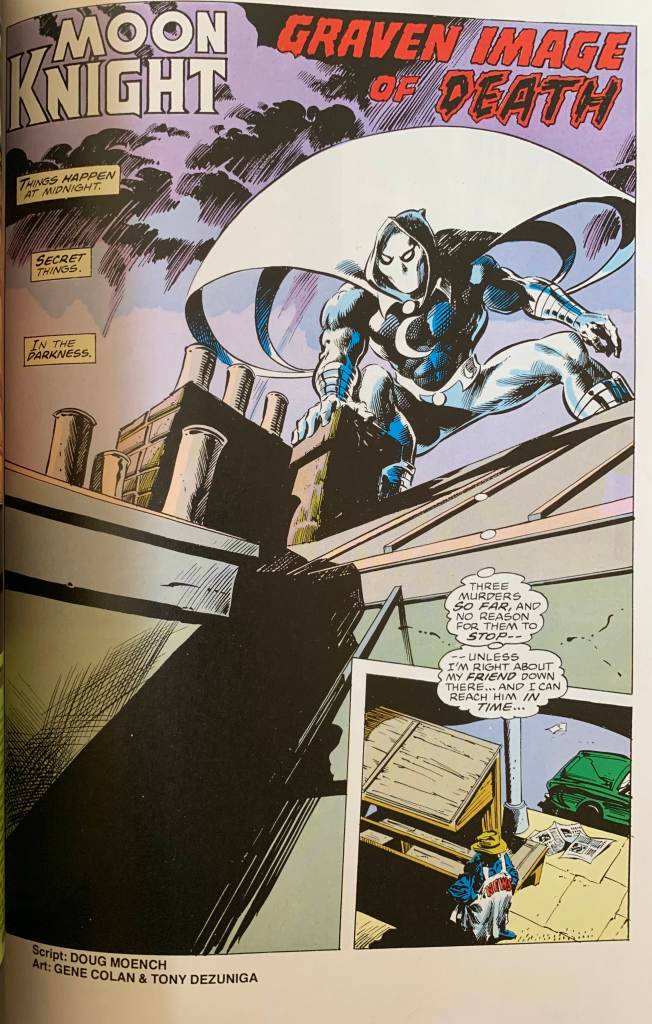
The story begins with a classic stakeout from the top of a building – a framing device common in Batman but completely unrealistic for most stakeouts. Moon Knight is anticipating an altercation but, unlike Batman or Superman, or even Spider-Man, he is unable to prevent the murder. Moon Knight may be super, but is not super-powered. He quickly jumps down after the murderer and changes his attire to Jake Lockley, the cab driver, and picks up the murderer. Moon Knights DID is depicted as granting him different skills depending on who he is at the time – Lockley is not a great fighter, for example. By transforming into Lockley, MK is able to get closer to the murderer and see where exactly he is heading. Most other superheroes would just tail the murderer, and perhaps that would be a more efficient way of going about it, but Moench is able to play into MK’s strengths and present him with scenarios in which he can use his personas to his advantage. When they arrive at the mansion, MK attacks the murderer during his costume change – remember, the costume equals the persona, the persona equals the skills. He cannot fight as well as Lockley, so he changes his costume to reflect the skill set he needs. He beats up the murderer, using his Moon Darts as a calling card of sorts, then receives a key. Moench and Gene Colan do a wonderful job in this particular panel of showing the key that MK receives while not having him actually comment on what it says. Later in the story, he will figure out what the code on the key means, but at this point in the story he does not know so he doesn’t comment. He then hogties the murderer and places him in the back of the cab while he interupts the meeting. MK has a pretty grey sense of justice and morality at this point in time, and has done actions that have resulted in the death of assailants. Obviously kidnapping a murderer is not, in his eyes, a crime.
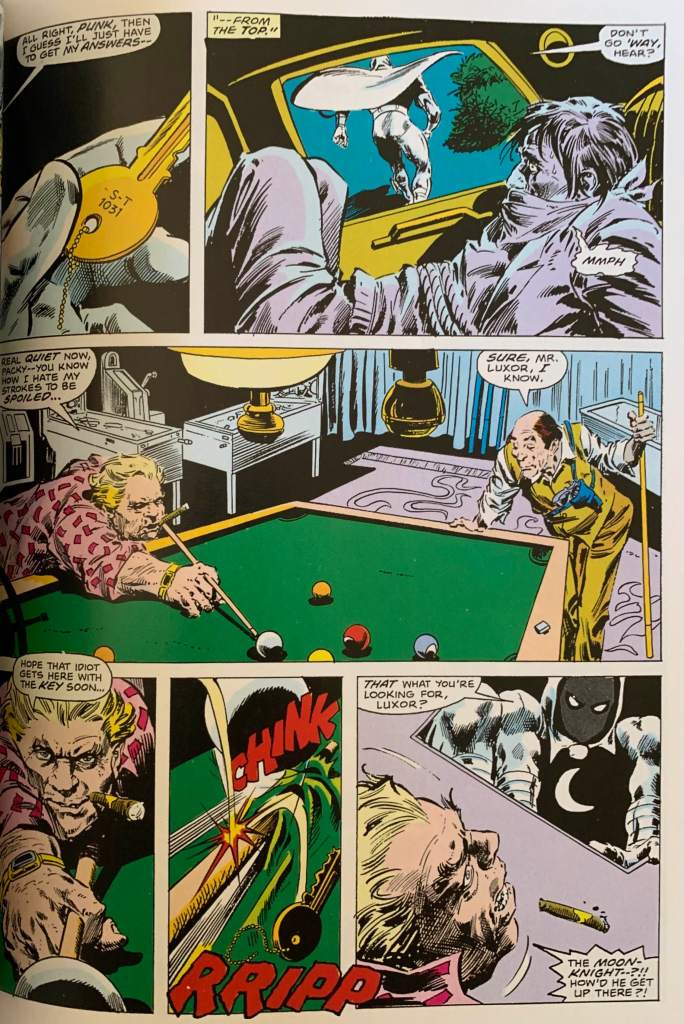
Moon Knight enters the foyer through, presumably, a HVAC ductwork system (one of my complaints about this issue is the lack of framing in most scenes, kinda hard to tell where things are spatially), and throws the key on the billiard table. This is another great example of Moench differentiating MK from other detective super heroes – he does not know what the key goes to, but knows that the murderer is supposed to drop it off. He overhears the men playing billiards say “hope that idiot gets here with the key soon..” confirming the other persons story. He throws the key, distracts the man in question while he lunges to grab it, but at that moment, the window shatters and a bullet strikes the man, killing him. Once again, MK is not infallible – jumping in on an outnumbered fight in close quarters is dangerous, even for someone so well trained, and he was unable to apprehend the man for questioning before someone decided to cut loose-ends. MK then contacts Steven Grant’s girlfriend (don’t ask!) Marlene, and asks her to come over to the mansion to investigate while he follows the clue of the key. MK has a vast cast of supporting characters, many of them knowing that MK and Marc Spector are one and the same, and he frequently has them help so he can be off doing other things. While similar to Karen Page’s role in Daredevil, Karen was never aware that DD and Matt were the same person, and she was always just helping Matt. As MK goes to leave, he finds the “bullet” – it is in fact a musket ball! He goes outside and finds Lockley’s cab missing, and calls on “Frenchie” (a stereotypical frenchman who is well versed in all things mechanical, think Lucius Fox from Batman) who shows up in the Moon Knight branded Helicopter to take him to the Sun Times newspaper publication.
Moon Knight reaches the Sun Times and finds Curt, a man who I do not believe we have been introduced to prior to this, but seems to be familiar enough with Moon Knight that he is not super surpised to find him there. They find that the locker key does fit one of the lockers there, meaning that the man who was murdered at the beginning of the comic had been an employee of the paper. He was doing an expose on a piece in the local museum, which is where MK is headed next. He enters the museum and finds that the piece is actually a fake – the curator, Crane, had done a bait and switch. MK then rushes over to Crane’s apartment to see if he can find the missing statuette – but not before noticing a missing musket from the museum display. One of the problems with writing a super hero story in which the criminals are low-level street thugs is that you have to find creative ways to differentiate the villians from one story to the next. The way that Moench chose to approach that for this story is to have Crane be obsessed with relics. So instead of using a regular pistol or revolver (like the first henchman that MK took down from the cab used, or the other henchmen he took down at the billiard table used), he has him use an antique musket. Not practical, and not particularly more dangerous that a regular gun, but interesting and different enough to be appreciated. MK does not find anything immediately obvious in the apartment, but, when he opens the closet door, finds the first henchmen still trussed up from earlier! (MK has commented several times by this point on how this guy was in the stolen cab, but I honestly still forgot and was super confused at first!) This henchman serves as Moench’s way to catch the reader up to all of intricacies of the plot with who hired who and who is involved in this plot to steal ancient relics. MK then realizes that nobody quite has a plan – so much has blown up and all allegiance is forfeit, so he returns to the mansion thinking that would be the next logical place for Crane to go looking for this statue that he stole but apparently lost.
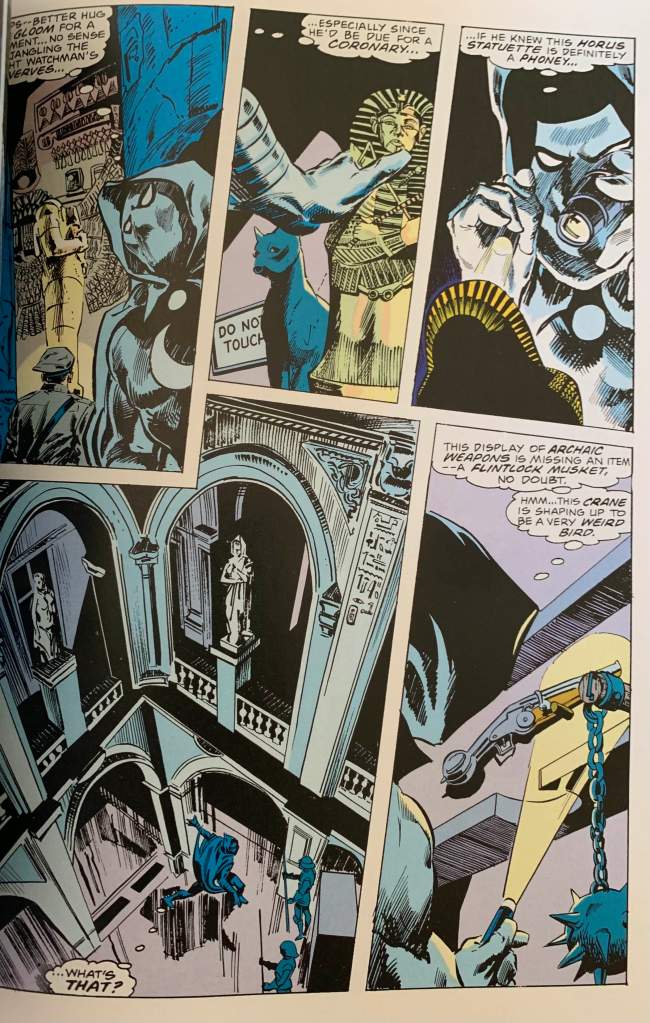
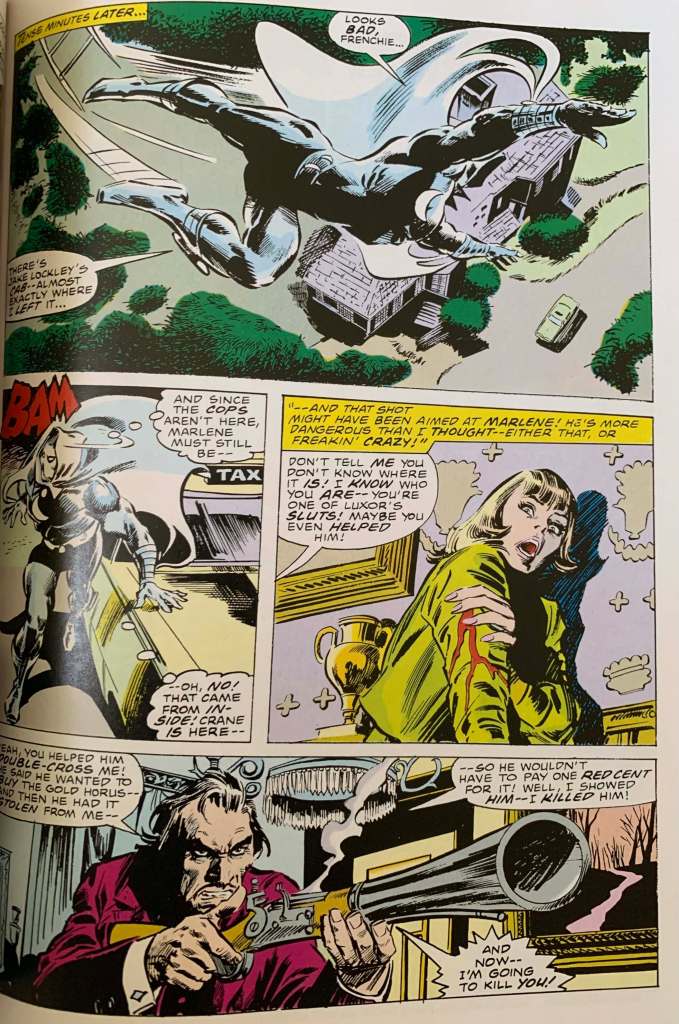
Moon Knight glides down from the Mooncopter (my term, not the comic) and sees Lockley’s cab has been returned, meaning that Crane is indeed back at the mansion. Which is a problem, since Marlene is also at the mansion looking for clues. MK hears the boom of gunfire and runs into the mansion, to find Marlene bleeding from an apparent musket ball in the shoulder and a crazed Crane aiming for another! The issue ends here, which is a phenomenal cliffhanger all things considered. Moench exceded all of my expectations when I first read this comic (especially considering in the Epic Collection that I was reading, this comic is number ten with all the other ones having been rather goofy in tone), and made me rethink my assumption with 70’s comics. Moench weaves quite a complex story in just these few short pages, introduces many villians with complex allegiences and motivations, and has a setting that reuses locations to show time is passing within the story. He reintroduces the reader to the character of MK and his supporting cast, acknowledging the fact that this is not a MK book and some readers might have no prior knowledge. The tone is quite dark, with many characters dying and the final page showing Marlene with blood dripping down her shoulder. MK is given well thought out scenarios in which to change personas, and is shown as an flawed hero who needs help to save people and, even then, cannot possibly save everyone. Moon Knight is a derivative character, he was obviously created to give fans of the Dark Knight another character to follow – but honestly, Black Panther and Daredevil have more in common with the Bat than Moon Knight does. Moon Knight is a wonderfully designed Marvel superhero who has had fantastic runs throughout the years that have relied solely on subverting expectations. The writers almost want the reader to believe that MK is just Batman, because once you believe that, they can pull the rug out from under you and leave you genuinely floored. And I believe that that all started with this issue in Hulk! 11.
If you are interested in reading this comic for yourself, and seeing the gorgeous artwork, I recommend either Marvel Unlimited, or picking up the Moon Knight Epic Collection: Bad Moon Rising. This storyline continues through Hulk! 12, 13, and concludes in 14.
 Vying For Time
Leave a comment