It’s just that everything is so different. What happened to the last five years? I’m stranded here not knowing what’s going on. I know I’m alive but I can’t feel it. – Spawn, Issue 1, page 19
This article is a continuation of part 1 of my retrospective analysis of Spawn issue 1 – you can read part 1 here! In the previous article, we ended with the full double page spread reveal of Spawn’s costume. Let’s begin with page 10.
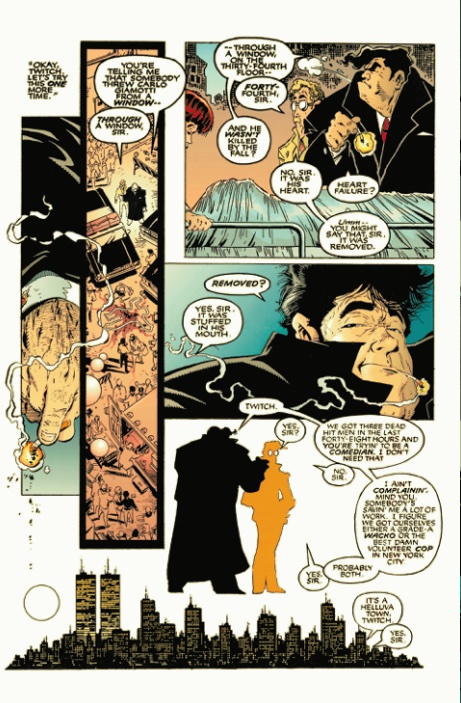
In my article showcasing August: Purgatory Underground, I discussed how one of the harder aspects of independent comic books is not having an established set of characters that the reader recognizes. McFarlane is no different with Spawn, and uses page 10 to introduce the reader to two of Spawn’s supporting cast – the NYPD Detectives Sam Burke and Max “Twitch” Williams. Sam and Twitch have some light banter back and forth and the basic dynamic between the two is paved out – Sam is the “cut-the-corners” kind of cop, while Twitch is very factual, to the point, and a little submissive. They show up and then leave quite succinctly, and I find this page to be a little hard to follow due to the composition. McFarlane is famous for this intricate character work, but he finds clever ways to avoid doing backgrounds whenever he can to save some time – and this page is a perfect example of this. This comic has been a slow burn up to this point – and with the full costume reveal being just a spreadpage earlier, McFarlane needs to knock it out of the park in the second half.
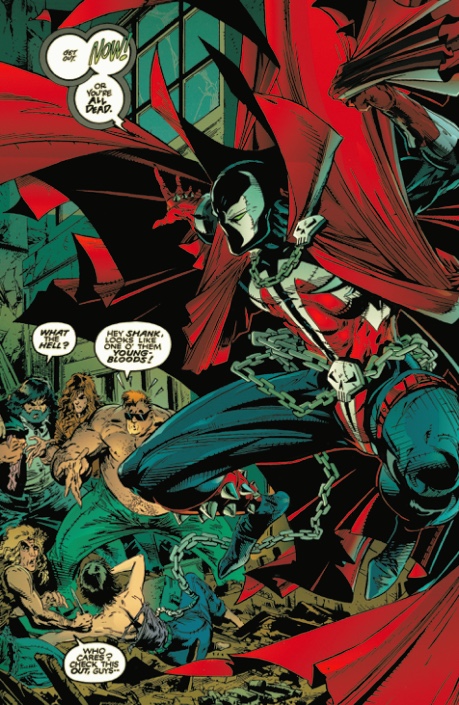
In stark contrast to my criticism of backgrounds and composition, this page shows a clearly defined setting (New York City’s dirty back alleys at night), and McFarlane uses Spawn and his bright red cape as a focal point, drawing the readers eye down towards the ground as he falls. Spawn is drawn to this alley in particular, hearing a group of thugs attacking a woman and ripping her clothes. This is the first bit of action in the comic, but also the first showcase of Spawn’s powers. He interupts the attempted sexual assault and most likely murder, and offers a chance for surrender (note: not something Spawn in 2025 would do). Interesting feature of the art here is that Spawn’s chains reach out and almost shield the woman from the attackers – Spawn doesn’t find out about his chain’s abilities until the next issue – nice foreshadowing! Spawn grabs one of the thugs and throws him through a window (also nice back reference to the conversation with Sam and Twitch in the last page), showcasing his increased strength. McFarlane focuses on small, bite-sized panels when showing action scenes, in a way of slowing down your reading and making the bigger panels more impactful. I especially like the duality between Spawn’s inhuman eye and the eye of the thug as he is viciously grabbed and suprised. In another use of his powers, Spawn sends out a single glint of neon green light at the remaining thugs and causes one of them to explode into nothingness. What exactly are his powers!?
In what is quite a common trope nowadays, Spawn then approaches the victim of the assault and she reacts with justified fear. Afterall, Spawn did just explode a man with magic powers. McFarlane then takes this opportunity to have a bit of a lore-dump. The pacing of this issue is good, with the story drip fed consistently every few pages – however, this action scene being cut short (he only fights two of the four assailants) and then being used as a bridge between story dumps, does feel bad. We are then exposed to more of the backstory of Spawn through a vision of a woman in grieving garb and a coffin with the flag draped over it. The coffin is Spawn’s, though the woman’s identity is unknown at this point. There is a nice cameo in the next page with the woman’s face morphing into the grotesque face of a demon very reminiscent of a villain yet to be introduced! In what might be a first for comic book super heroes, Spawn is then shown in the embrace of the woman he saved, being caressed and nursed back to his senses. One of the things that I love about Spawn as a series is the way that McFarlane is able to use Spawn as a standin for his own life and experiences. In a day and age where men were not shown in vulnerable states, especially not super heroes, it is quite refreshing. Spawn is practically new-born to this world and has very little knowledge of who he is and where is belongs.
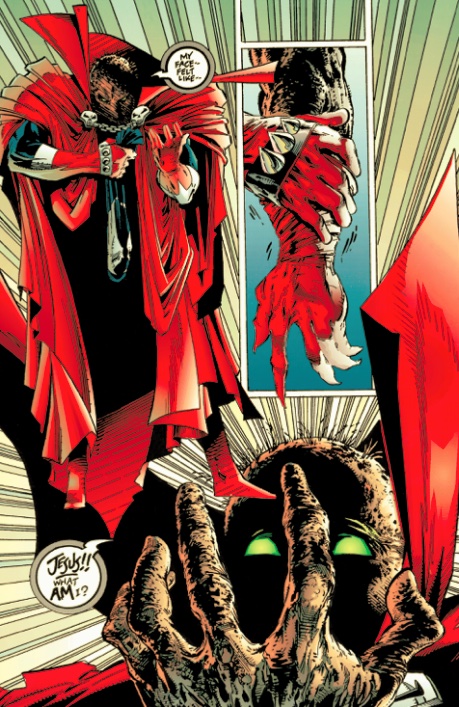
Page 18 is, once again, is a full page of the news reporters; this time showing the year as 1992 – five years after the last time we saw them. While I am not a fan of so much story dumping, I do like the fact that the reporters are shown having aged since the last time – the woman for CNN has a new hair cut, the logo for “Today 2” is updated and modern, and the final reporter is working for a different company entirely. The reporters are discussing events pertaining to what Sam and Twitch were mentioning earlier, which is a nice throwback and shows a good grasp of overall story. There is also a nice wink and nod to another Image title at the time, “Youngbloods”, from the final reporter as he is talking about sightings of Spawn. I enjoy the fact that McFarlane is keeping a consistent level of confusion between the side characters, Spawn, and the reader when it comes to who Spawn is. He really plays into the fact that this is an issue 1 and makes you want to continue reading to answer some of those questions. We get some answers in the following page, page 19. The woman Spawn keeps seeing is his wife, and here we have the best reveal and hook for an issue 1 that I have ever read – Spawn makes the claim that “he is no hero” and tries to take off the costume. In doing so, he reveals that his face and whole body is horribly scarred and disfigured – he is dead.
The issue ends with a final page depicting Sam and Twitch talking about the mysterious murders that have been happening around town – who is killing them? Spawn? And then the reveal of the first big bad – a twisted, pot-bellied yellow Demon who seems to know more about Spawn than he does himself. After careful analysis of this issue and looking at each page individually to see how the add or subtract from the whole, I feel that we can finally answer the original question – is Spawn issue 1 an example of 90’s excess or 90’s excellence? I believe that this issue is a good first issue for an independent character – Spawn is stark as a design, he is an interesting character with a mysterious past and motivations, and the supporting cast introduced are tropey but get good mileage and use in moving the story forward. The art is great, with no reliance on 90’s “T&A” (google that at your own risk!), and effective use of splash pages and varied framing shots. There are hitches in the issue, mainly the use of story dumps (4 full pages of exposition in a comic of only 22 pages, with only 3 pages of action to balance them out), and confusing use of the power meter which is not explained in this particular issue. There are many poor examples of 90’s comics, but this one is definitely not one of them – though there is an argument to be made that this comic is bad when compared to the comics of the 80’s or even 70’s. Todd McFarlane had a singular purpose with Spawn – create a badass comic in which a badass character can exist and show off – and that is accomplished in this comic.

 Vying For Time
Leave a comment