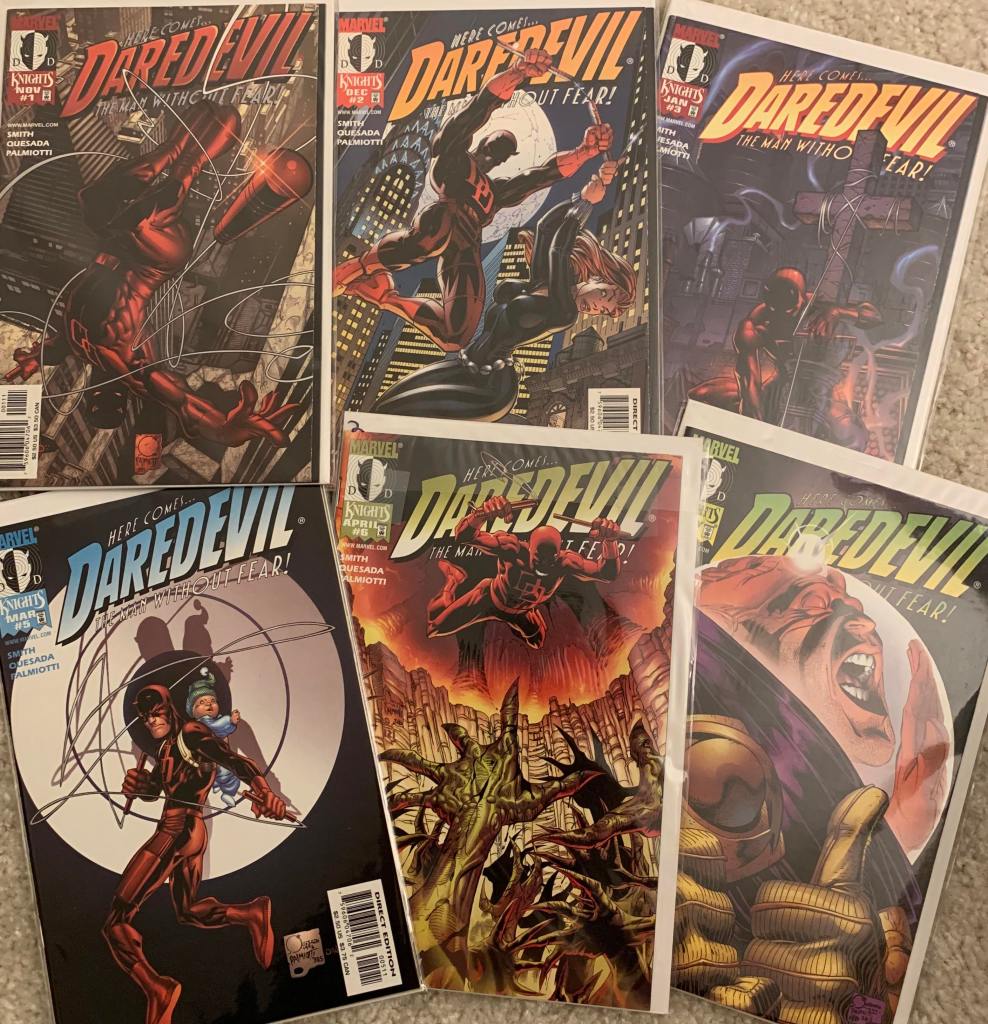
Whooo boy what a first week. I really try not to be negative on this website (there is enough negativity In the world right now without me bringing any more into it!), but this week was rough. As stated in my previous post (go read it if you haven’t! It’s short!), I had read both Daredevil: Guardian Devil (DD:GD) and Black Panther: The Client (BP:TC) previously and did not like DD:GD one bit. And to no one’s surprise, I stand by that assessment. Daredevil: Guardian Devil written by Kevin Smith with art by Joe Quesada and Jimmy Palmiotti, is the first 8 issues of volume 2 of Daredevil from 1998. The story revolves around a mysterious young girl claiming to have given birth to a baby through immaculate conception, and Daredevil is tasked with the safety of said child. I will be analyzing the story based on a few criteria – how well the story is written, how good the art is, what the story means for the greater plot at hand, and how well the characters act according to previous iterations. Let’s continue with DD:GD and just rip the bandaid off.
Story:
The story follows the classic rising action, climax, falling action structure, and is actually a very well constructed work. The story begins with Matt reading a letter from Karen, his long term girlfriend announcing she is leaving for the west coast to pursue job opportunities. She claims that her ‘low point’ in her life is leaving residual disdain from Matt, and that she doesn’t want to feel like he’s giving her a second chance. Matt reacts poorly, feeling conflicted about whether he does honestly feel that way. He retreats to his church for confessional, but during confession he hears two nearby heartbeats and a car apparently chasing them.
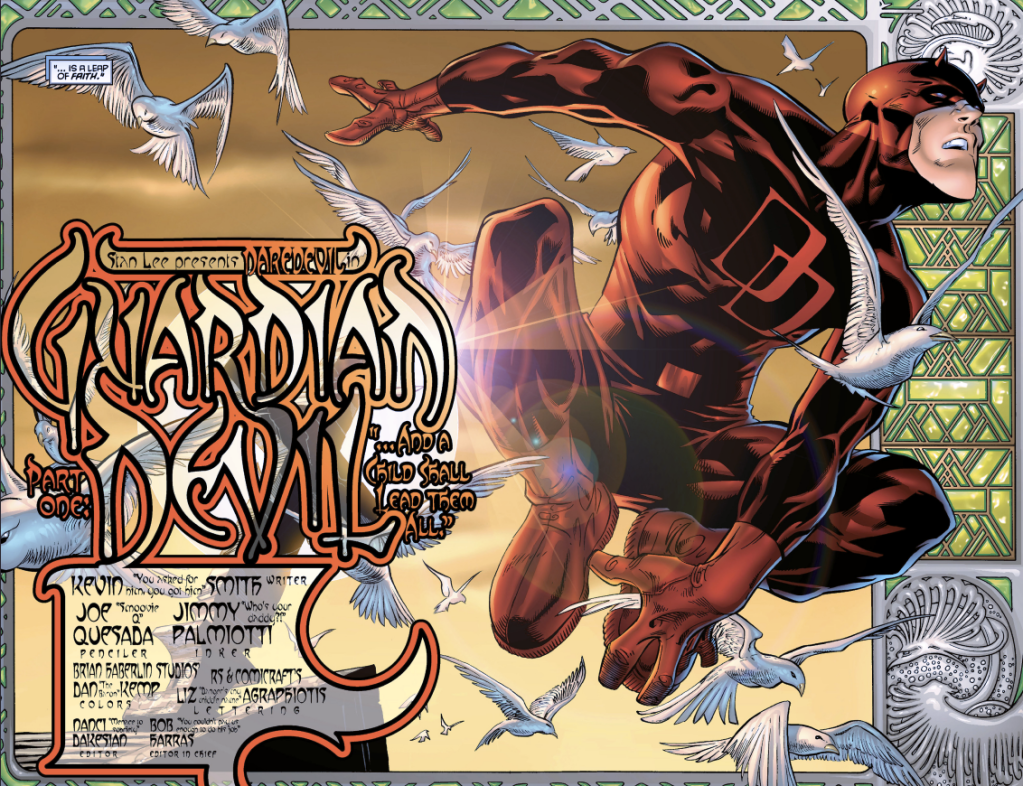
He stops the car chase, but the two heartbeats are nowhere to be found. We then cut away to the two heartbeats which belong to a young girl and a newborn baby. She recounts how her family did not believe the circumstances of her pregnancy, namely that she is a virgin, and that her family was brutally murdered shortly after the child’s birth. She then sees a vision of a biblically accurate chorus of angels who give her instruction.
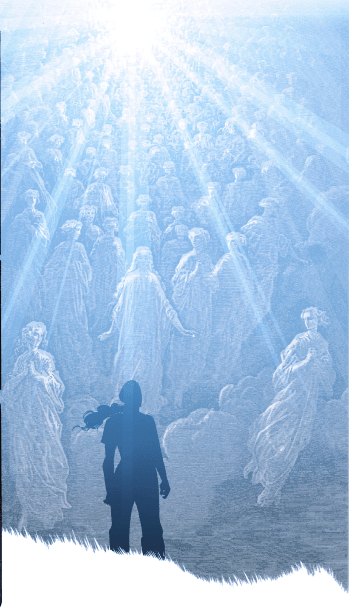
She shows up at Matt’s law office of Sharpe, Nelson, and Murdock, and tells Matt about the immaculate conception, and then ending with that the angels told her that Matt is Daredevil. Thus concludes the ‘exposition’ and begins the ‘conflict’ – the baby. All in all, the story up to this point is good. Nothing too crazy, good amount of Catholicism and interesting mystery. But the rest of the story is just bad.
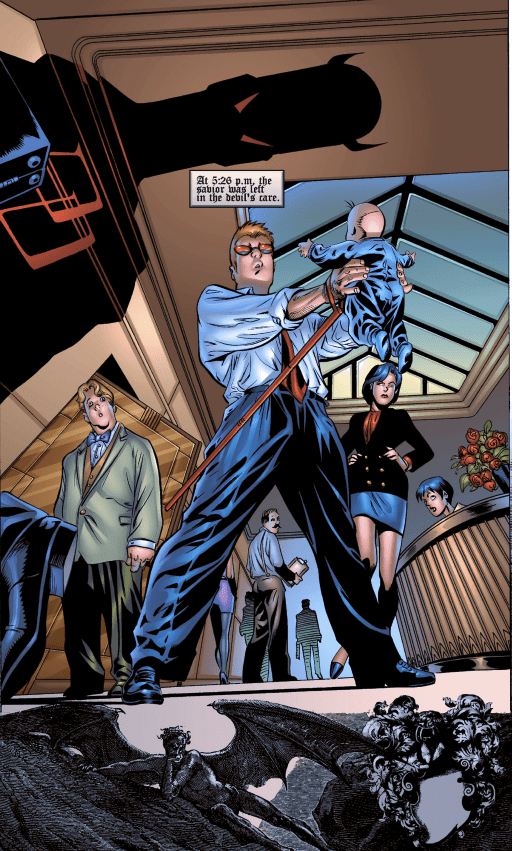
The plot quickly spirals out of control with 4 points of view – Matt, Foggy, Karen, and the antagonist. Matt is approached by an older man claiming to be part of an organization called ‘Seol’. They believe that the child is the antichrist, and that Matt needs to hand him over to them so they can kill it. Matt refuses, and the man leaves but not without a warning that by keeping the baby alive, horrible things will happen to not only Matt, but his friends! He also reveals that he knows that Matt is Daredevil! Foggy, meanwhile, is romantically involved with Liz Osborn, the widow of Norman Osborn (Green Goblin from Spider-Man). He is approached by a woman seeking a divorce attorney, which Matt notes is not something their law firm does, but is informed that this woman has been sterilized by her husband which Foggy takes special affront to. Matt is then shown at his apartment when Natasha (Black Widow) shows up. She comments on Matt being a past love interest, and correctly calls him out on contacting her only after he and Karen take a break. He declined her sexual offer, instead making her watch the baby so he can investigate its birth certificate. We jump forward in time to Matt returning to his apartment with Natasha having left and Karen knocking on his door distraught. She tells him she has HIV.
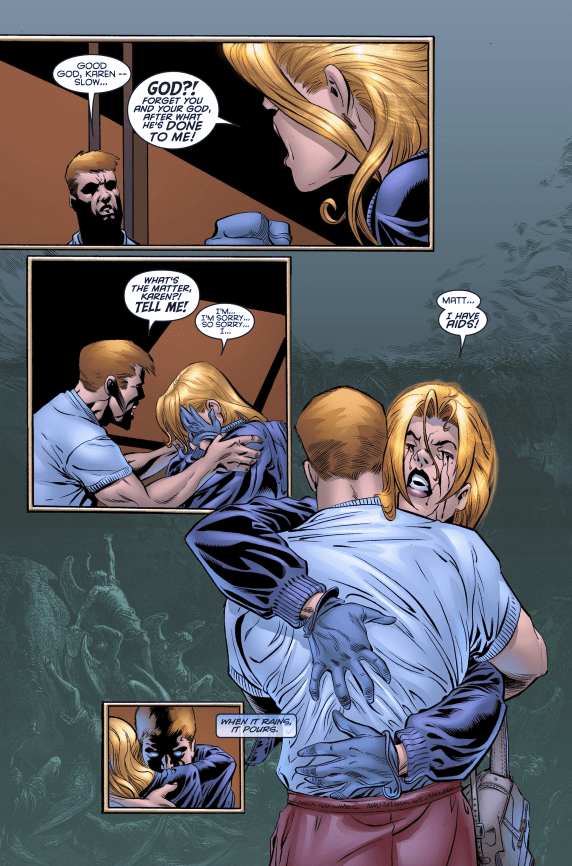
We have very little time to digest this revelation (unless of course we are in 1998 reading this monthly!) before Foggy calls to tell Matt he’s been arrested! This is the part in the story that I begin to get frustrated – I do not feel that the portrayal of these horrible situations being attributed (seemingly) to this baby is appropriate. Does Karen actually have HIV, or is it the baby warping things? Is Foggy arrested from something he actually did, or is it the baby? I feel like these are disingenuous things to joke about in a comic, since most things in comics are not permanent. I understand Smith wanting to up the ante and increase tensions, but the HIV diagnosis of Karen is too far.
The next two issues follow the fallout of these events – Foggy is in jail for rape, with claw marks across his face from the woman who he claims turned into a demon during sex and jumped out the window after clawing his face. Super weird and gross.
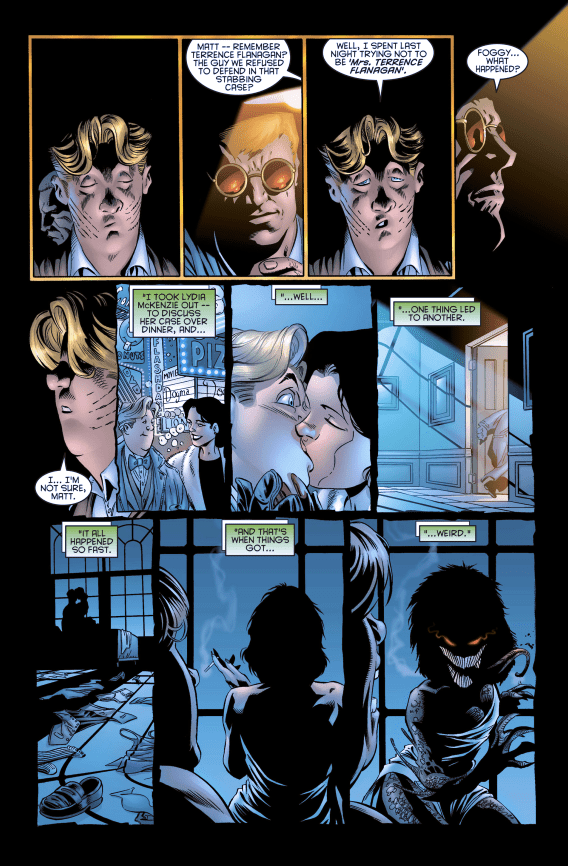
Karen is recounting events in her life that could have resulted in her diagnosis, when she is approached by the same man who met Matt, explaining that the baby in Matt’s possession is the antichrist and that if she turns the baby over to them then her HIV would go away I guess? There’s also a super awkward section of this random man talking about how her promiscuous lifestyle and wanton drug abuse lead to her diagnosis but was too many years ago to have been the cause? Super weird and gross. Matt meets with Natasha and explains that all of these horrible things happening are the result of the baby and literally throws it off a building but Natasha saves it in time. Super weird and gross.
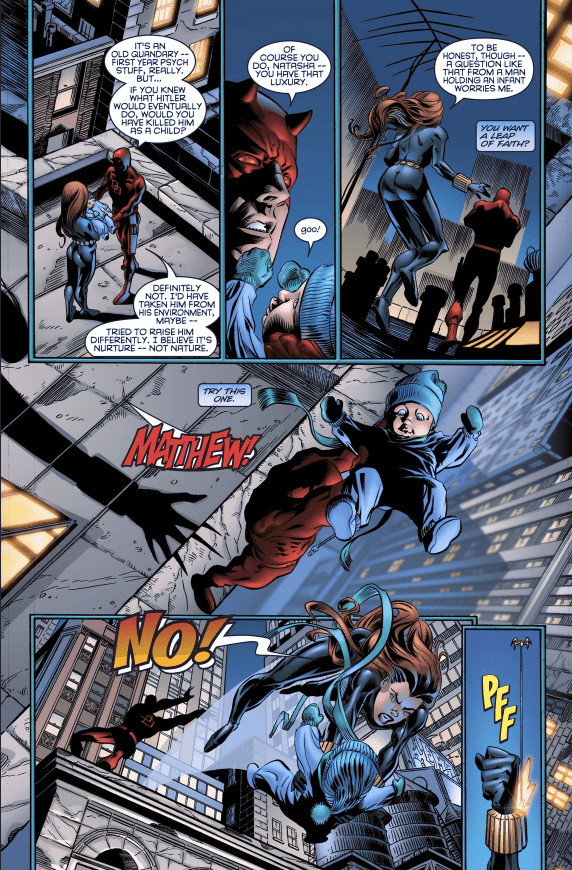
Do you see the theme here? I understand that Smith is wanting to show how these characters would react under duress, but I cannot see a world in which Foggy has an illicit affair with a random client, or where Karen contracts a life altering STI from being an escort, or where Matt throws a baby off a building Odysseus style.
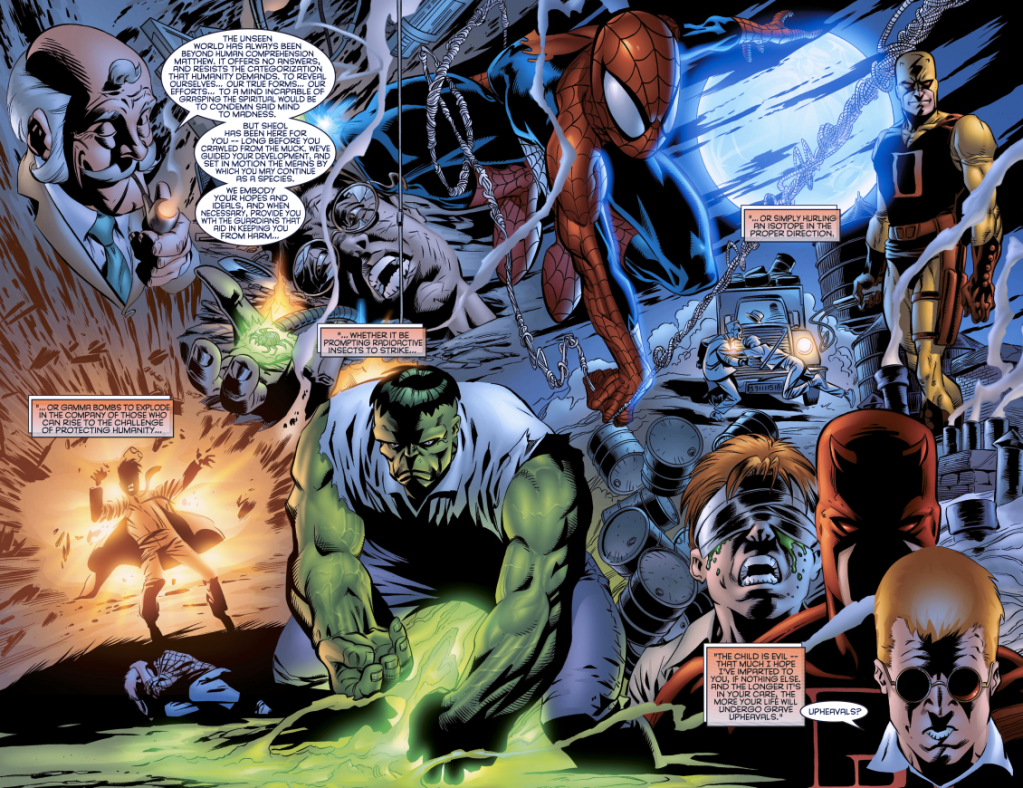
The rising action of the story begins when Matt visits Dr. Strange to see about a strange relic he was given by a man claiming to be an angel named ‘Baal’. This relic, Matt assumes, has some trace magic on it that might lead them to answers – but Strange reveals there is no magic present, but actually contains a ‘invisible, scent less neurotoxin’ that creates hallucinations and ‘strong emotional responses based on trigger topics’. And thus, Smith believes, he has sufficiently explained the out of character actions of Matt, like throwing the baby off the building. But, I would have to point out, that Matt’s powers are literally a side-effect of his loss of vision and increased strength of his other senses, therefore it would be incredibly unlikely that he would 1) have hallucinations since they are usually linked to vision, and 2) not be able to sense the poison. Alas, that’s the explanation we are given. Strange then summons Mephisto, to ask him if the antichrist has been born again, but instead of giving a clear answer he references the Bible, and in doing so, elicits a response from Matt who supposed to remain silent else he would attract the attention of the demon. Mephisto then taunts Matt by telling him that something bad is happening at the parish that his birth mother is a nun at.
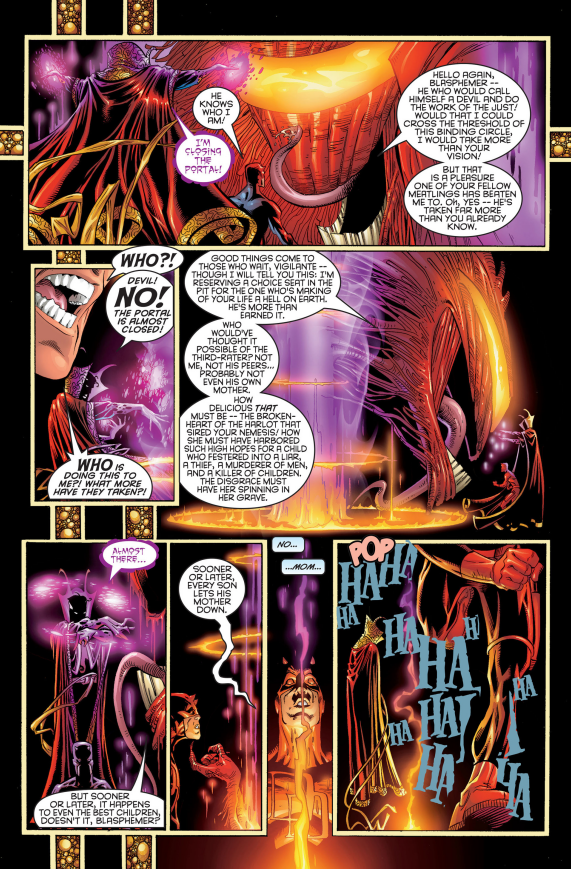
He rushes over there to find Bullseye on killing spree searching for the baby. He is about to kill Matt, when Karen shows up and offers him the baby in exchange for Matt’s life. Bullseye gladly makes the trade, but before leaving, throws Matt’s Billy club back at him and Karen jumps in the way killing her. Thus brings us to the only ‘good’ part of the book, in my eyes. The death of Karen Page, while incredibly unnecessary (especially in this story) is a great way to differentiate the 90’s daredevil run from the 60’s original one. This daredevil promises to be darker, more mature, and more unpredictable than any run before. I still question Smith’s inclusion of the HIV plot point, since she would die from Bullseye regardless, but I guess it doesn’t matter in the end.
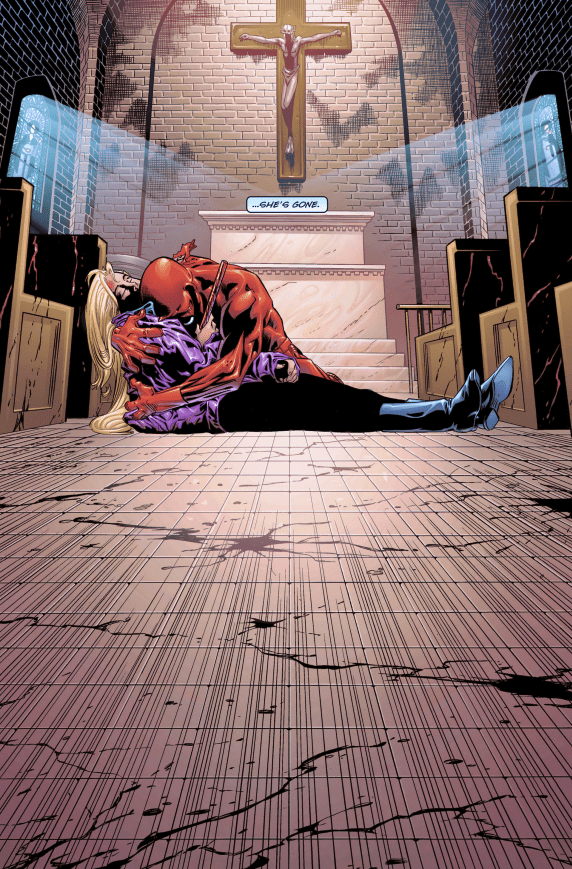
The next issue begins with Matt remembering Karen and putting a gun to his head in a suicide attempt (similar to what he did when elektra was killed by bullseye at the end of the Frank Miller run). The raw emotional weight of these last few issues began to weigh on me with this one and I felt so emotionally drained that I couldn’t really react to Karen’s death. Foggy is in jail, fired from his law firm, Matt quit the law firm, had his long-term girlfriend die in his arms, had his friend/ lover black widow run away from him after he threw a baby off a building, and now said baby is the hands of bullseye who is a killer. All in all, a very low point for the story. Matt realizes that to honor Karen, he will save the baby. He fights down some low level gang members (even having a run in with Turk!), and gets the address of a new gang that he believes is the one hunting the baby. He fights through the building, running into ‘Baal’ again, but attacks him and realizes it is a man in a costume. He gets to the top and finds out who is the big bad who has been pulling the strings the whole time – B-list Spider-Man villian Mysterio! I am torn on how I feel about Mysterio being the villain – on one hand, Daredevil has a long history of fighting Spider-Man villains so it’s not that surprising, but on the other hand, it does feel like a move out of right field.
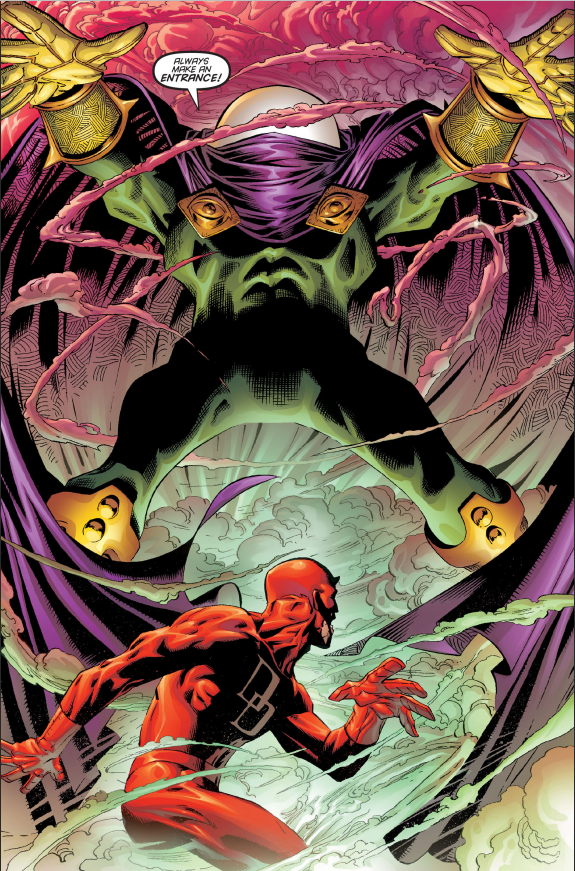
The entire rest of the comic reads like a rushed confession. Smith was only originally supposed to write 6 issues – as confirmed in one the early letter pages, but somewhere in the release of the first few issues his run got extended to 8 issues. I’m not sure when or why the change happened, but even with 2 more additional issues, Smith still spends an entire issue with Mysterio just explaining the convoluted plot to Matt. Mysterio was diagnosed with inoperable cancer and decides that he needs to destroy Spider-Man before he died – but realizes that the spider-man running around during this time (clone saga) is not Peter, so instead goes after Daredevil(?) because he stopped him most recently. He tracks down Kingpin and pays him a million dollars (in 1998 money – almost 2 million in today’s economy) for all the information he has on Daredevil.
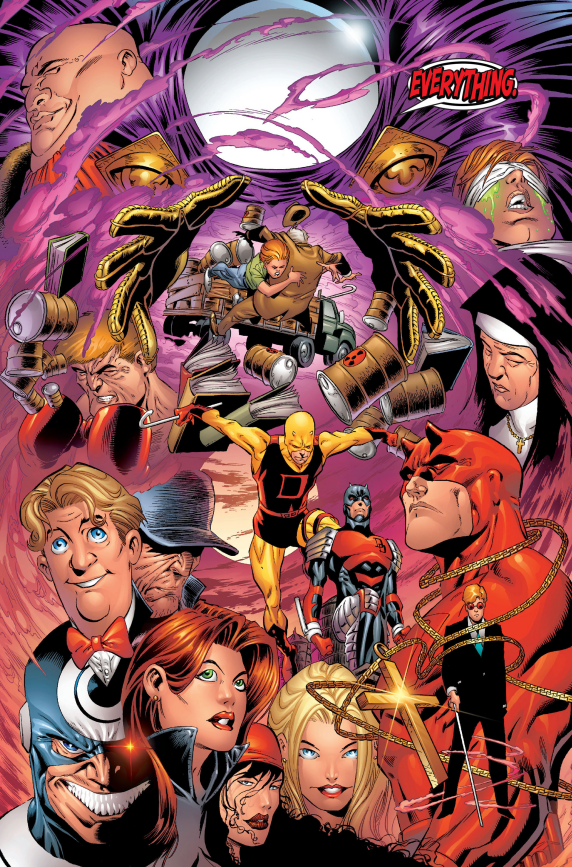
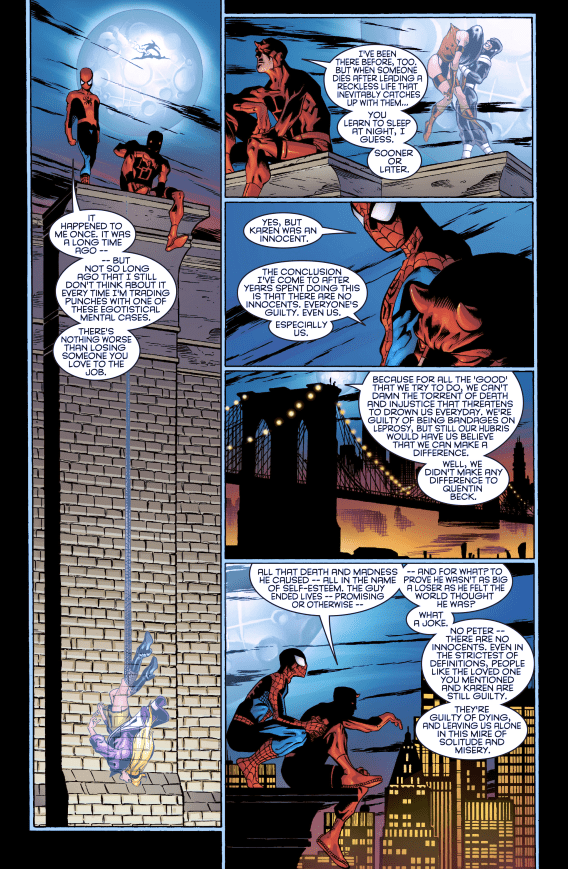
This explains why so many people in the book knew his secret identity. He then used his animatronics, move projections, and props to create a biblical themed con that would bring Matt to his breaking point and possibly cause him to murder a baby. The girl in the beginning was captured and artificially inseminated (weird and gross), her family murdered before they could investigate who’s sperm it was (even weirder and grosser – I guess it was Mysterio’s???), and Karen’s medical records were forged. Foggy’s one night stand was not actually a real client but a drug addict that was being blackmailed to play the part (though she really did commit suicide – weird and gross), and Bullseye killing Karen was just an accident. Whoops. Honestly, the story kinda fizzles out here – it feels too much like the curtain being pulled back in the wizard of Oz. There is no ‘Ah-Ha!’ moment of realization or epiphany – just a series of weird and gross explanations. Matt saves the baby, Mysterio kills all the witnesses and then ends up killing himself. Matt goes to the funeral for Karen and has a wonderful moment with Peter about their quest to defeat evil and how it feels like they can never catch up.
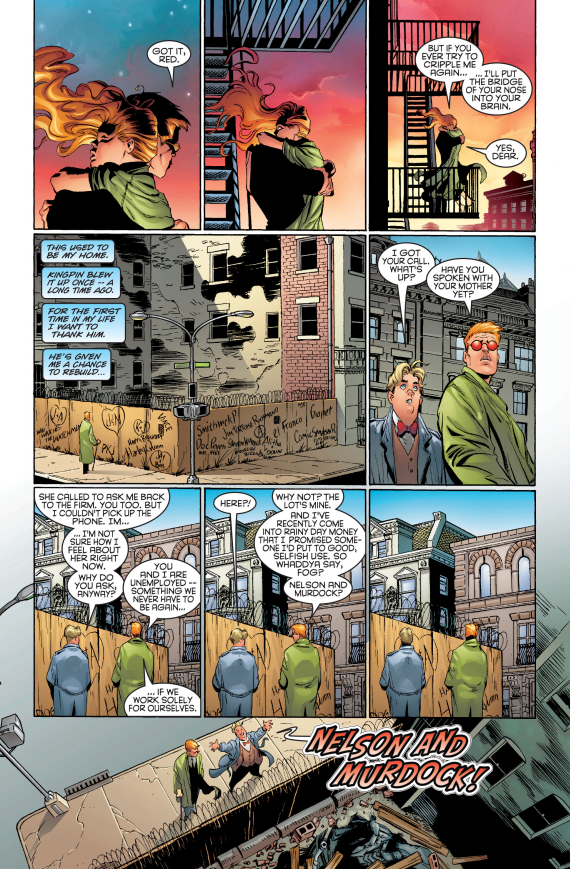
He apologizes to Natasha, who, like a champ, just shrugs off the infanticide attempt and says she is still game for a flirting relationship any time he is. Matt finds Karen’s will and sees that he is her beneficiary – and meets with Foggy who has been cleared of his charges and announces they are opening ‘Nelson and Murdock’ back up on the same lot that it was prior to ‘Born Again’ when Kingpin destroyed it. And that, finally, is the end of Daredevil: Guardian Devil.
Art:
Joe Quesada and Jimmy Palmiotti are one of the quintessential artist pairs of the 2000’s. There is just something so distinct about their art together that screams late 90’s early 2000’s. Everyone is strangely shiny, the colors are weirdly digital and don’t blend super well, and Quesada’s proportions, especially on Daredevil, feel alien. He often has ambiguous backgrounds, and relies on panels with just busts talking frequently. However, that being said, they do produce some fantastic action scenes and depict classic marvel super heroes in very distinct ways. While this book is primarily Daredevil, Quesada still manages to draw Black Widow, Dr. Strange, Spider-Man, and even the fantastic four (albeit out of costume) at the funeral. Mephisto, Kingpin, Bullseye, and Mysterio are all incredibly detailed and hold true to their 80’s designs. The colors are deep and dark, which fits the overall tone of the story. I did get annoyed at how much of the art is blocked by Smith’s mountain of word balloons – especially in the Mysterio issues.
Long Lasting Impact:
There were 2 major character deaths in this storyline, those of Karen Page and Quentin Beck. Karen has stayed dead since then (to the best of my knowledge), while Beck was dead for a few years but has showed up in various stages of ‘undeath’ and has recently been revived. Nelson and Murdock gets rebuilt, bringing the pair back to the status quo introduced all the way back in the 60’s. Bullseye and kingpin are reintroduced with their new motivations, Kingpin being broke and a ‘kingpin’ only in villain moniker, while Bullseye is working for the highest bidder as a mercenary with no real allegiances. The relationship between Foggy and Liz is ended, although I admittedly have not read the prior comics in which they were dating, but that does leave Foggy single going into volume 2.
Characterizations:
This is the one aspect of this story where I can say quite definitively that Smith missed the mark by a mile. I don’t feel like a single character of the main Daredevil cast (Matt, Foggy, Karen) acted in character this whole story. Matt is a lawyer, and naturally skeptical, but trusts random people implicitly in the story. He cowers before Mephisto, even though he beat him during the inferno crossover. Not even mentioning him throwing a baby off a building. Foggy is depicted as a adulterer, even if we dismiss the whole rape allegations. And Karen goes without saying, though I will give Smith a slight pass since he wasn’t the one who made Karen a prostitute.
Verdict:
I do not typically do number rankings, but I do want to rank all of the stories during the CBBC. My rankings will be as follows:
[S] Rank – Stories fundamental to the character; worth hunting down and purchasing regardless of your familiarity with the character
[A] Rank – Wonderful stories adding layers to the lore; great place to continue learning about a character
[B] Rank – Stories that are fun and interesting but do not add to the character; worth reading digitally, possibly owning if you like the character
[C] Rank – Generic stories that don’t feel like they belong to any particular super hero; read as part of an online subscription only
[D] Rank – Stories that detract from the overall character; not worth owning unless a hardcore collector of that character
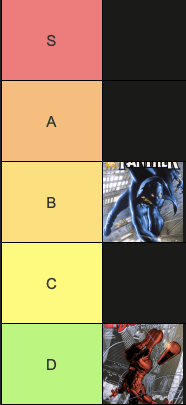
Based on those above rankings, I feel that Daredevil: Guardian Devil is the first (and hopefully only) [D] rank. The only reason I even feel the need to include this story in my reading order is because of the death of Karen Page. This story has major implications for volume 2, and we can only go up from here!
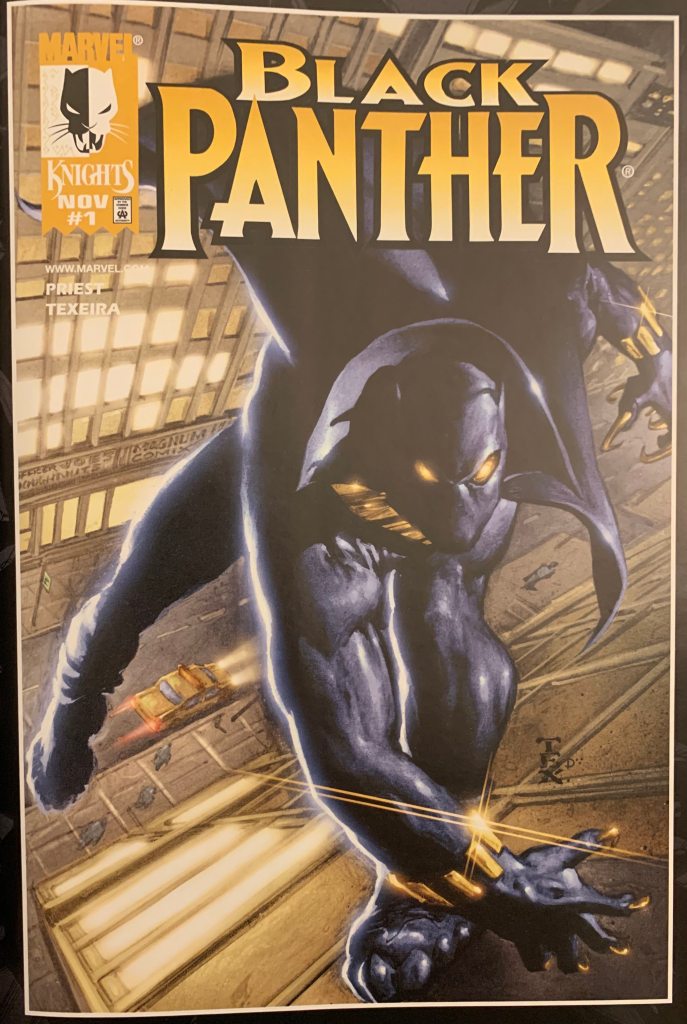
Now, let’s turn to Black Panther: The Client – the first 5 issues of Black Panther written by Christopher Priest with art by Mark Texeira and Brian Haberlin, with guest artist Vince Evans on issue 5. This run also started in 1998 and coincided with the Marvel Knights imprint. This story revolves around King T’challa, the Black Panther, in New York City from the perspective of Everett K. Ross, a member of the State Department who’s job is to escort foreign dignitaries. I will be analyzing this story based on the same criteria as DD:GD – the strength of the story, the artistic choices, the greater role the plot has on the future stories, and characterizations.
Story:
In contrast to DD:GD, the story of Black Panther: The Client is told in reverse from the viewpoint of Ross, not T’Challa, the Black Panther. We still see events that Ross was not a part of (like events in Wakanda), but Ross is always the ‘eyes’ that we see out of and the narrator for the story. We begin in media res, with Ross standing on a toilet, pantsless, with a gun aimed at a huge rat.
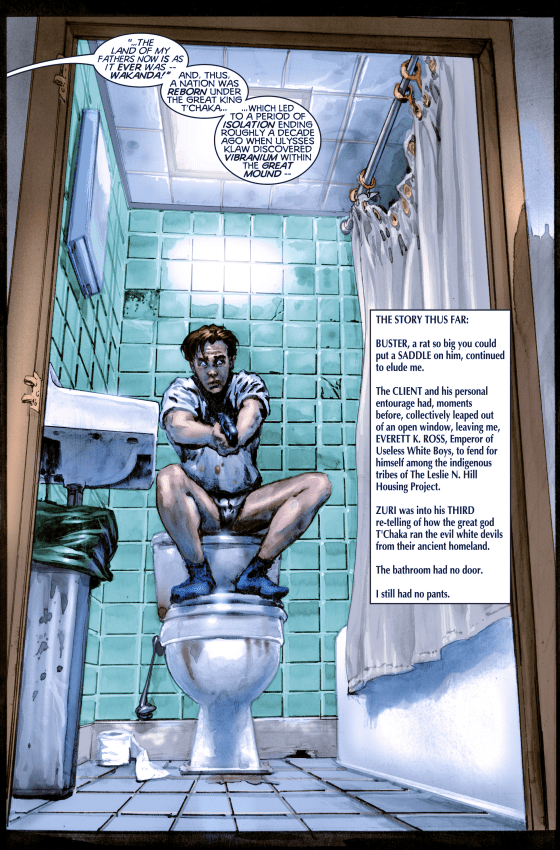
Priest often uses humor to juxtapose the campiness of black Panther (a grown man in a cat costume), while still making you think T’Challa is a badass. Ross explains why he was on the toilet – because there was a huge rat – but not truly why he was there, to the frustration of his girlfriend and boss, Nikki. She is trying to understand what went wrong during T’Challa’s state visit, and Ross is the only one who can answer that – but instead of giving a detailed account (like a detective or a professional) he is obviously shaken up by all that he has seen and cannot focus on a singular timeline.
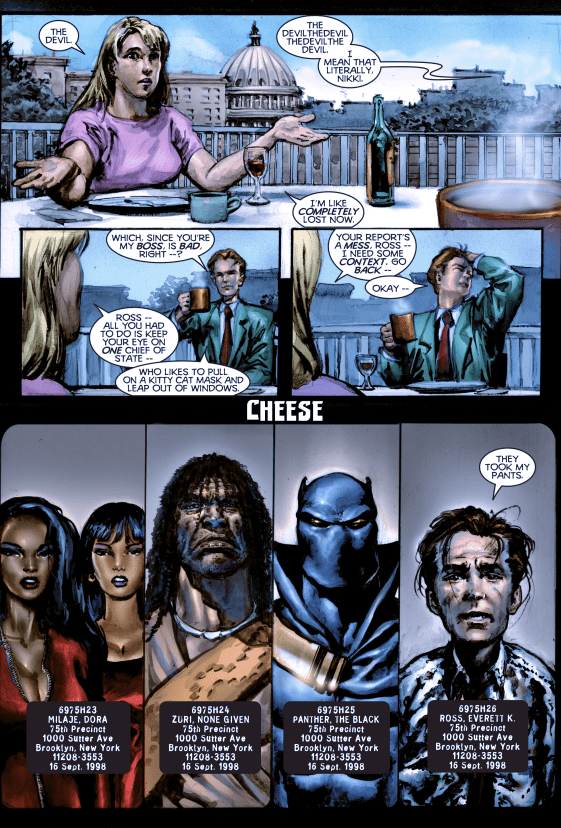
He finally goes back to earlier in the night with T’Challa and the Dora Milaje (a new creation of Priest’s) confronting some drug dealers on the street. T’Challa, Nakia and Okoye subdue them, with T’Challa taking the leader into the alley and transforming into the Black Panther.
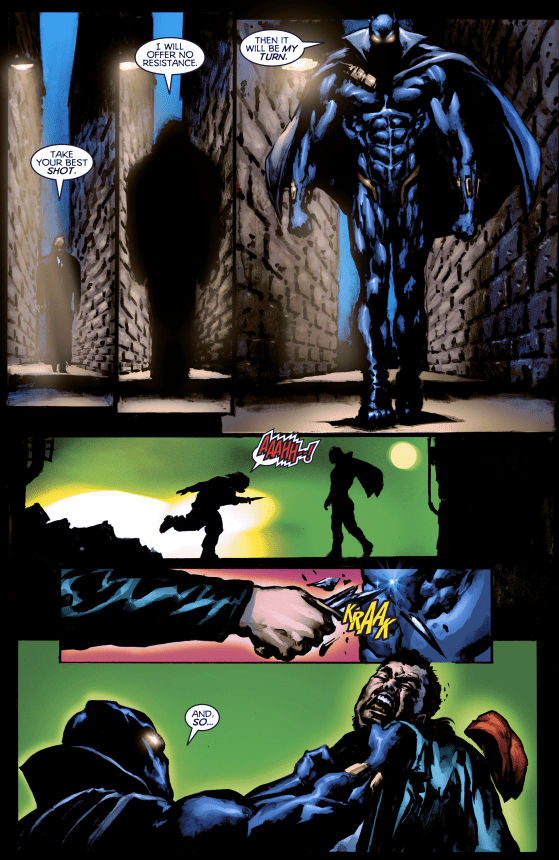
He lets the leader get the first strike in, to which the knife breaks upon Black Panther’s suit, and then he drags the man by his hair up the side of a nearby building. He marks the man with a vibranium dagger (also new) and tells him he now works for the Black Panther as he is investigating the death of a child in the ‘ tomorrow fund’ (which we don’t know what that means yet). Nikki finally throws wine on Ross’s face and he goes back to the true beginning of the story – King T’Challa and the “Tomorrow Fund” death.
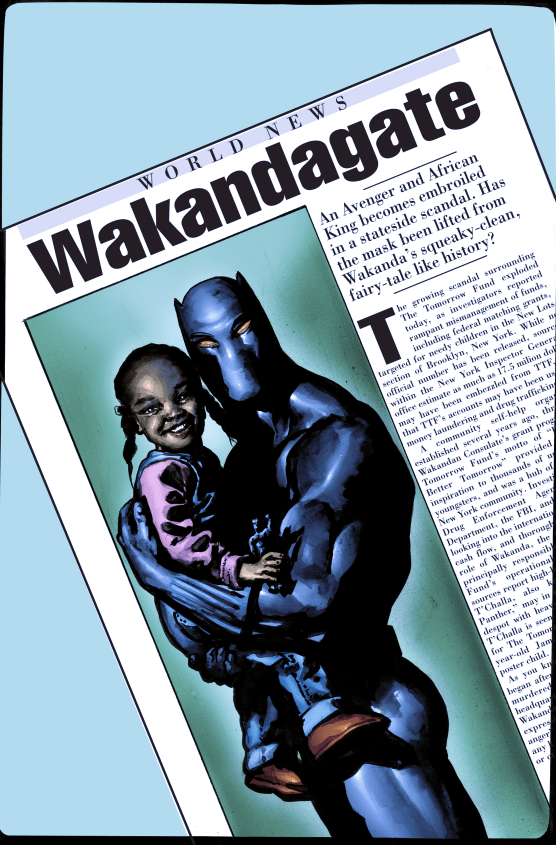
The Wakandan embassy in New York created a fund called ‘The Tomorrow Fund’ targeted for at-need children in the Brooklyn area of New York. Apparently, money had been miss-allocated and possibly embezzled, which came to light from a child dying in their care, who just so happened to be the literal “poster child” for the group. T’Challa leaves Wakanda even though he is battling tensions between Wakandans and refugees sheltering in the nation, and takes a diplomatic trip to the United States – which Ross, correctly, points out is ironic since Black Panther is a member of the Avengers and comes to the United States all the time. Ross then jumps ahead, again, and tries to explain what happens after he’s standing on the toilet with a gun without wearing pants – the devil (Mephisto) knocks on the door.
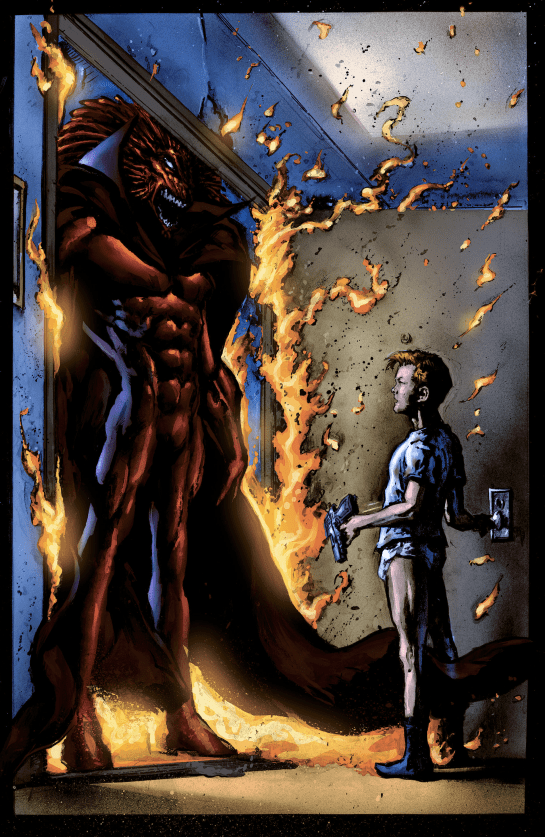
And that is how the first issue ends. We are given plot threads and glimpses into half a dozen different scenes without closure on any single scene – a trope that Priest is famous for. We are introduced to new characters and ‘teams’ in the form of Ross and Nikki of the state department, and Okoye and Nakia of the Dora Milaje. Let’s continue into the next few issues!
Issues 2 and 3 follow a similar pattern of Ross giving more story beats but less answers – showing scenes of trying to get dinner for T’Challa and Zuri by speaking Cantonese in a Chinese restaurant, only to have T’Challa speak Mandarin back to the confusion of Ross. Or Ross getting his wallet and ID stolen and hunting down the thief, only to be thrown into a mud pit with half naked women who beat the crap out of him. Ross is a stand in for the reader – and specifically the white readers. He misunderstands T’Challa’s motivations and goals, misrepresents his culture and hero mantle, and assumes that he is just some ‘African Prince’ demanding money through an AOL phishing email. Unlike DD:GD, the plot is anything but linear. I would be remiss to try and explain the story beat by beat because that’s not really the point. Priest does not have the luxury of continuity on his hands with Black Panther – while Smith’s DD:GD came out the month after the finale of series 1, there had not been a main Black Panther title in 7 years prior to BP:TC. Priest had to not only make people want to read the next issue, he had to make them want to read about Black Panther. Therefore, for my sanity, I’ll instead just follow T’Challa’s story of dealing with the ‘Tomorrow Fund’ and the fallout of the dead child. T’Challa spends the rest of the night hunting down gang bangers and drug pushers looking for leads on who corrupted the leader of the ‘Tomorrow Fund’. T’Challa believes that corruption starts from the top, and that the leader is to blame.
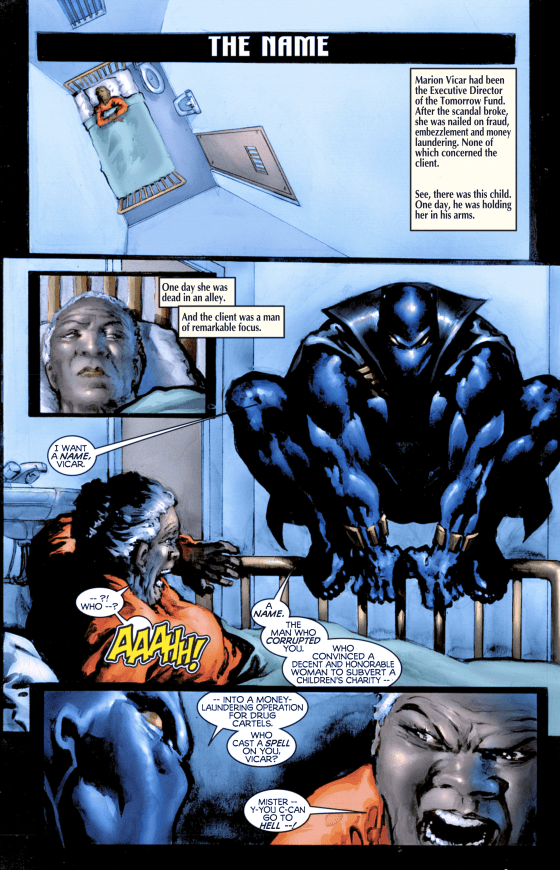
He meets with them in jail and has Okoye come in and beat the information out of her. She gives the name of the person who introduced the idea of money laundering and drug peddling, Achebe, as well as the name of the person who paid her for the ‘use’ of the child. T’Challa refuses to create an international incident by killing someone on American soil, but does not hold back much when dealing with the child molester – he lights him on fire using pictures of the child as kindling, then throws him out the window of a skyscraper and catches him just before he hits the ground.
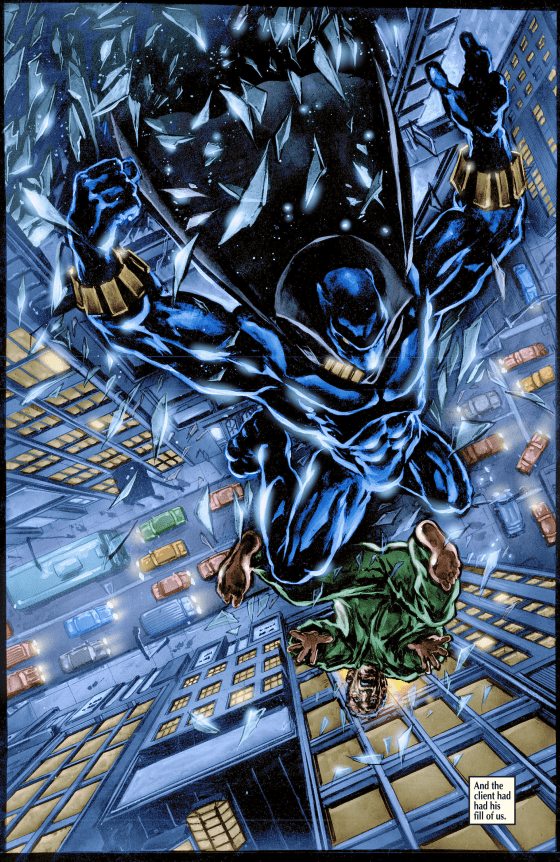
He throws him in the trunk of their car then drives to the home of the mother of the child and lets her dish out the punishment. To his suprise, the mother just wants him to be inprisoned (a theme for the whole run – T’Challa does not understand western conventions of justice and punishment). We then have a flashback and introduction to the character of Achebe – the person financing the tomorrow fund’s’ money laundering and drug pushing. Achebe is another new character created by Priest and is a nice foil to T’Challa – T’Challa believes that Wakanda is inherently better than the rest of Africa. He is not selfish in this observation, taking in refugees who seek to leave their African territories and countries, but he simply believes that Wakandan vibranium is divinely inspired. Achebe, on the other hand, believes (similar to the Joker to Batman) that wakanda is one bad day away from becoming embroiled in factional infighting and destitution.
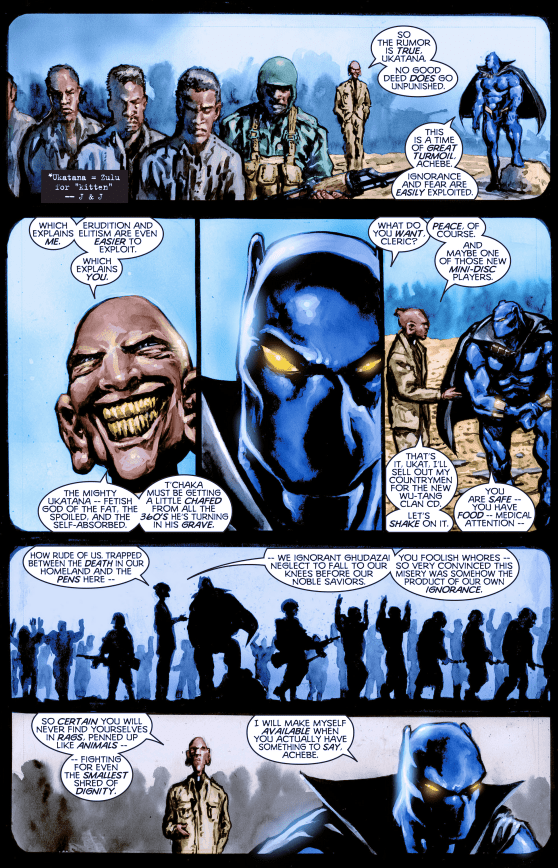
And, to that end, Achebe has been working behind the scenes for years to bring about this conclusion – he fostered the racial and tribal wars that raged in the neighboring countries leading to the refugee crisis for the sole intention of straining Wakanda’s resources and good will. He funded the tomorrow fund’s downfall and lead to the mismanagement of funds and death of the poster child, knowing that T’Challa would feel personally responsible and leave Wakanda to take care of it: thus allowing Achebe to take control of the throne. Even in trying to simplify the story into a more linear narrative I realize how convoluted the plot really is. I have often wondered if you took all of the mismatched scenes and put them in order if the story would even be a good one, or is the story only enjoyable because of the wacky juxtapositions and hard right turns. At the end of issue 3, we have the basic information needed for a true plot – we have the setup with Achebe, the (re)introduction of black Panther and his group, the setting of New York and Wakanda, and the supporting cast in the form of Ross and Nikki. We have seen Mephisto and the Hatut Zeraze (we see them at the end of issue 3, but the introduction is in issue 4), but don’t know their true role yet, but know they are antagonistic. We still don’t quite know how the story gets resolved, though we do know that Ross is retelling the account to his boss so it obviously does get resolved.
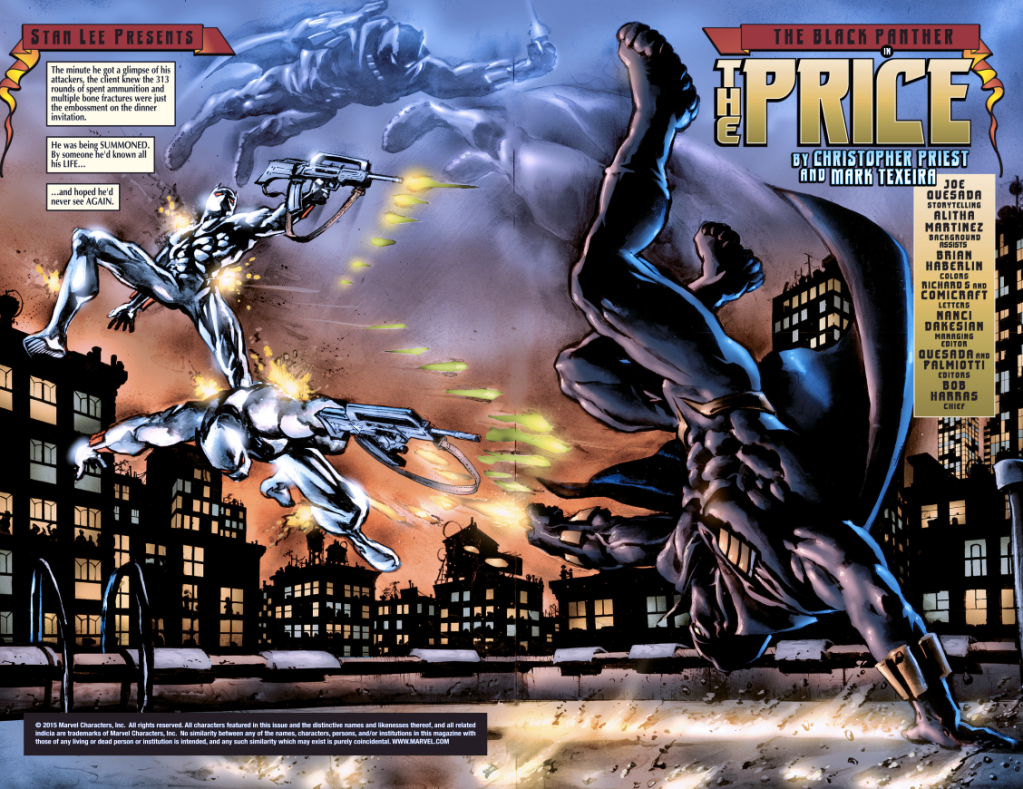
Issue 4 picks up exactly where issue 3 left off – with the aforementioned Hatut Zeraze stalking Black Panther up a building. T’Challa defeats them after a short but devestating battle and summons their leader Hunter, the white wolf, who explains that they were mearly testing T’Challa’s leadership ability. We are then given their backstory and roll in Wakandan society – they are effectively the Wakandan secret police that remove political opponents through torture and execution. T’Challa (unsuccesfully) disbanded them when he assumed the throne, but they have been monitoring the situation in Wakanda and are wanting to exterminate the usurper Achebe. T’Challa warns them of the ramifications of such a move, to which Hunter issues his own warning for T’Challa – “there’s a demon waiting for you at your flat.” And now we get back to the original antagonist of the whole 5 issue arc – Mephisto. How interesting that the villain for this arc of Black Panther happens to also be a villain that appears in DD:GD, which came out at the same time? I know that Quesada and Palmiotti were outsiders to Marvel that were given the keys to several of their characters, but I can’t help but wander if they thought Mephisto to have a bigger role in the greater Marvel Universe that they were creating. Nevertheless, Panther returns to his flat in the tenement buildings to find Ross and Mephisto chilling on the couch together, and Panther knocks Mephisto out with a single hook to the face.
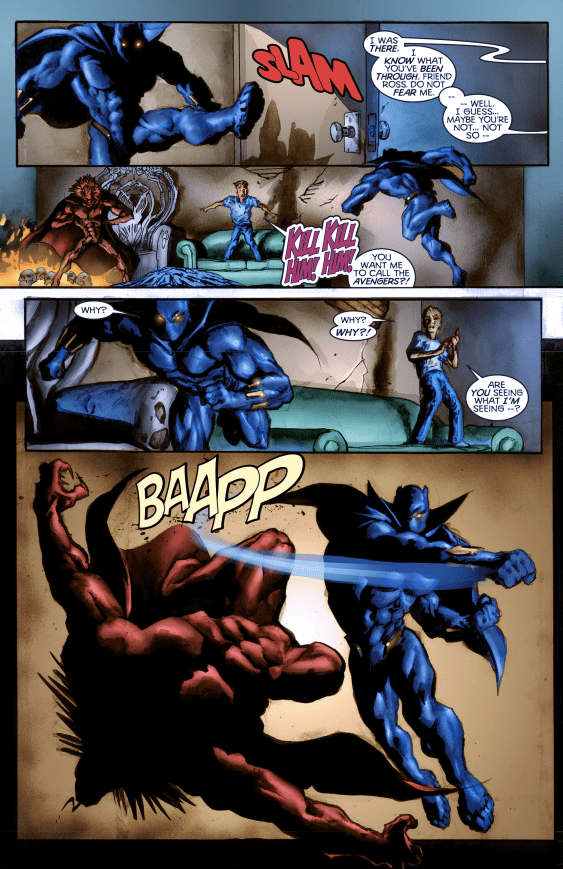
Turns out, T’Challa had people monitoring the flat and were analyzing Mephisto for any weaknesses in his demonic magics. Metaphysical pseudoscience aside, Panther rips the heart out of Mephisto, hands it to Ross, and then begins to negotiate the swift removal of Mephisto’s influence on Achebe (oh yeah, apparently Achebe’s power is derived from Mephisto himself. I forgot about that earlier). Instead of playing ball, Mephisto then teleports not just he and Panther, but also Ross, to hell itself. Ross begins to freak out.
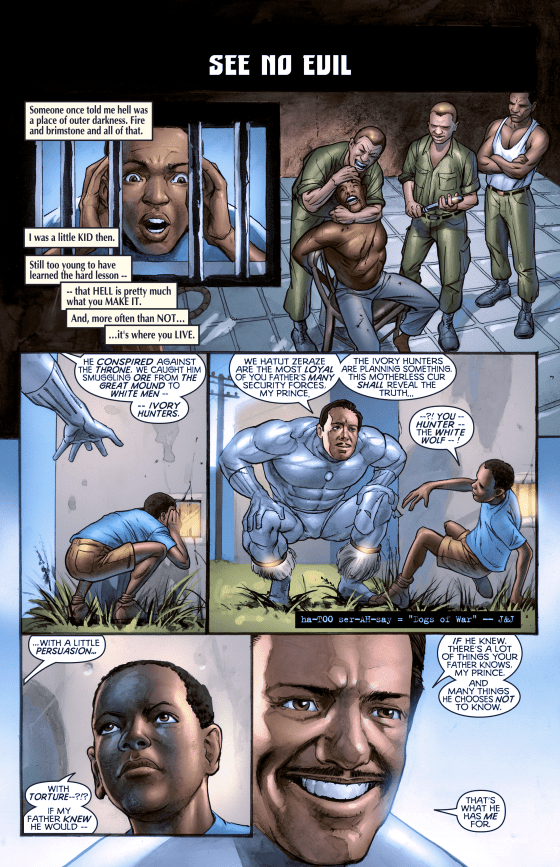
The last and final issue of the first story arc is an odd one – up to this point we have not truly gotten the origin story of The Black Panther. And this is strange, especially since, like I mentioned earlier, this is the first Black Panther run in 10 years. It is safe to assume that most people reading this comic are only vaguely familiar with the character from his appearances in the Avengers, where he is just another member of the team with no flashy powers. But also, this issue is the first without Texeira on art, replaced by Vince Evans. I will talk more about the art in the next section, but it is very jarring to have the finale to a story arc done by a new artist. We have Panther and Ross in hell seeing formulative moments in their lives play out in real time – Ross’s childhood being bullied about his weight, and T’Challa’s childhood seeing his father murdered before his eyes. Priest does manage to deftly integrate the newly created Hatut Zeraze and Hunter into T’Challa’s origin story, with them being the ones who originally caught on to the presence of Ullyses Klaw.
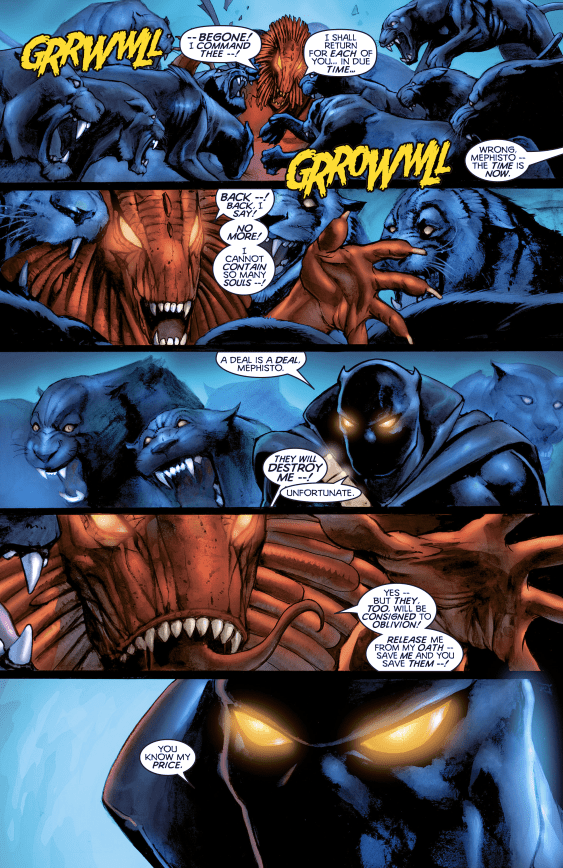
Panther breaks through the illusion and makes a deal with Mephisto – his soul [Panther’s], for the freedom of Wakanda from his influence [Mephisto’s]. Mephisto greedily accepts the offer, not realizing he has been outsmarted by T’Challa – his soul is no longer just his own, it is now the accumulated souls of all the Black Panther’s before him. These souls and manifestations defeat Mephisto causing him to release T’Challa and Ross and to leave Wakanda alone from his machinations.
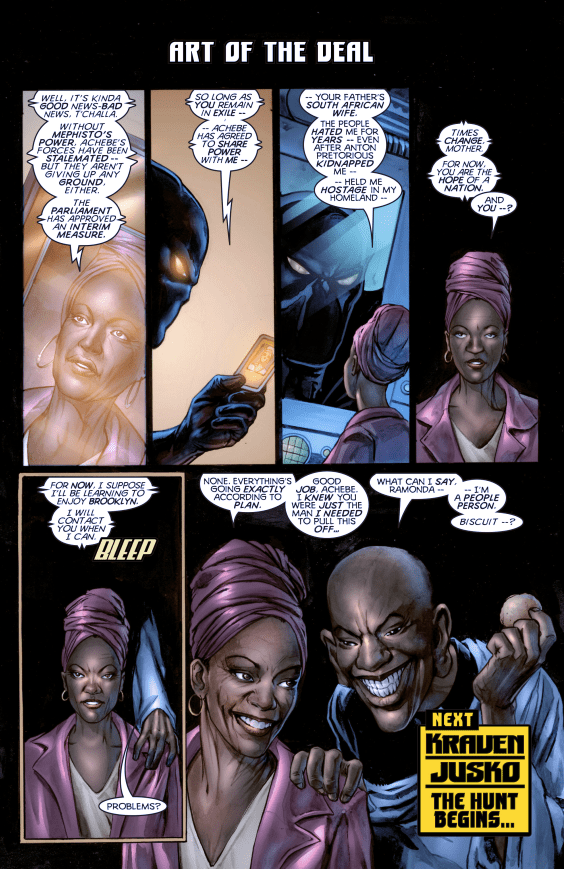
In the final page of the issue, we find out what T’Challa and Hunter were alluding to earlier in issue 4 – Achebe is just a pawn, and the true person taking control of Wakanda is none other than Romanda, T’Challa’s mother (not birth mother, but N’Yami died during childbirth). This is effectively part 1 of a 3 part story ending in issue 12, but I will be following the collected editions and be stopping here for now.
Art:
I feel like I’m going to catch a lot of flak for my opinions in this section (as if I didn’t already from my absolute grilling of DD:GD) but I do not like Texeira’s art. I find his proportions and character work to be really static, and I do not like Haberlin’s colors. I do not get the feeling that I am reading a comic that takes place in the “urban jungle” of New York, and instead feel like I am looking at 20th century Muckraker photographs. Combine this with the fact that Priest’s narrative is non-linear and I feel like the whole presentation is muddy.
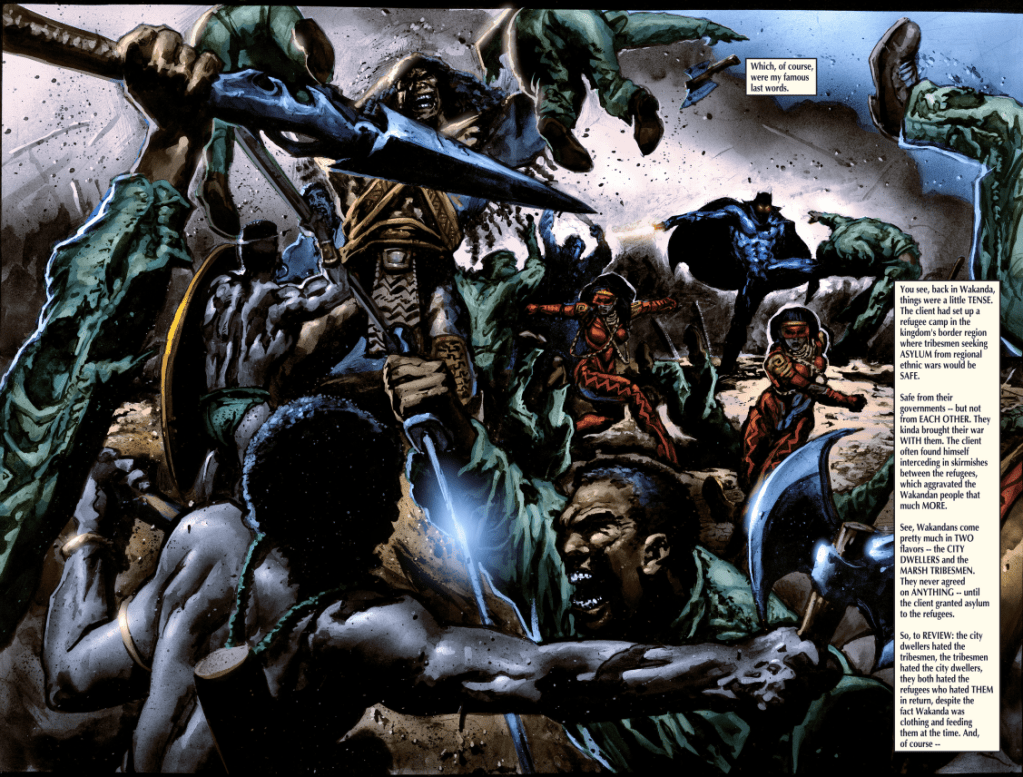
Ironically, the best art in my opinion is from the guest artist in issue 5, though still nothing to write home about. The action scenes are interesting and the backgrounds do a good job of cementing the space, but other than that I feel that the art is below average.
Long Lasting Impact:
Priest’s Black Panther run is such a character defining run and he is able to start that precedent in this first story arc. He created the Dora Milaje, the Hatut Zeraze, as well as Nakia, Okoye, Ross, Hunter, and Achebe. He created the vibranium energy daggers and the kimoyo card. I cannot overstate how much Priest changed the direction of the Black Panther. For that alone this run is worth reading.
Characterizations:
This is a difficult question to answer. On one hand, Priest writes T’Challa quite differently from Don McGregor or Jack Kirby, which should be a strike against him, however, every writer since has used Priest as the model. T’Challa is written similarly to Namor or Dr. Doom or Magneto, in the sense that he seems himself as so far above the common populace and 15 steps ahead of his enemies. He outsmarts the devil for christsake. The only other person in this comic that is an established character is Romanda, but since the story is not quite over I will not comment on her characterization.
Verdict:
I absolutely love this run of Black Panther, but I need to be objective and critical and feel that the best ranking I can do is a [B]. It is confusing and the art is not clear, but it is such a character defining run that you would be doing yourself a disservice if you did not read it. But, that being said, I cannot necessarily recommend buying issues 1-5. And, because that is the unecessary stipulation I put upon myself, that is the criteria in which I will be judging it. Read it digitally, or go find a cheap copy of Black Panther by Priest The Complete Collection vol 1, but do not blind buy the omnibus.
The Current Rankings:
As we conclude week 1, the current rankings are as follows:
Week 2 Readings:
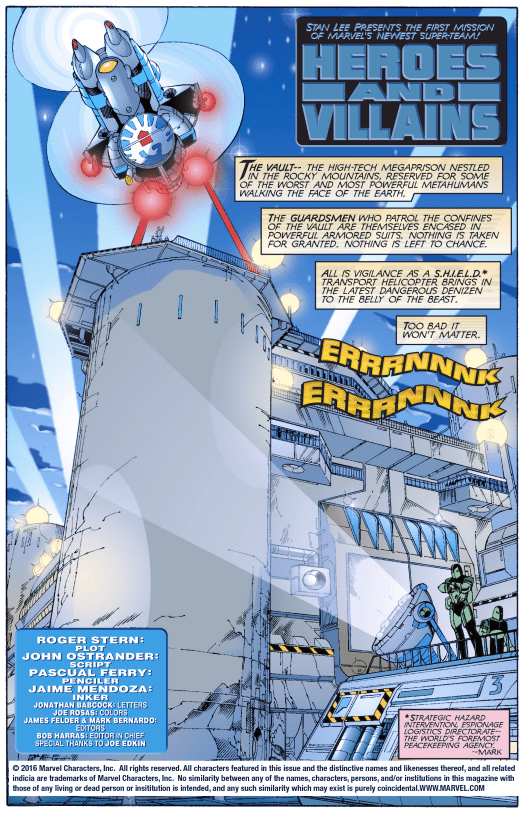
Next week’s storylines will be Daredevil: Parts of a Hole (1998 9-15), Black Panther: Hunted and Caged (1998 6 & 7), and Heroes for Hire: Heroes and Villains (1997 1-4). I hope to see you all there!

 Vying For Time
Leave a comment